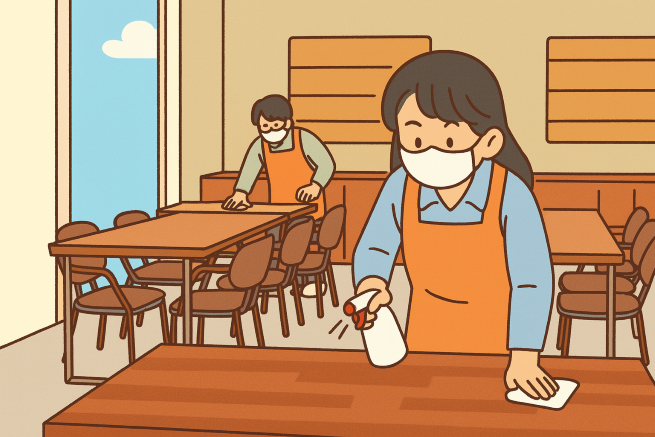
Restaurants continued to be the most popular part-time job destination for South Korean teenagers last year. (Image supported by ChatGPT)
SEOUL, July 24 (Korea Bizwire) – Restaurants remained the most common workplace for South Korean teenagers working part-time jobs last year, but new data suggests significant changes in youth employment patterns over the past decade.
According to a study released Tuesday by the National Youth Policy Institute, 39.3% of middle and high school students who worked in 2023 were employed in restaurants, far surpassing other sectors such as buffets and wedding halls (13.6%) and cafés and bakeries (7.2%). The findings were based on a survey of 915 students from ninth to twelfth grade.
This trend is consistent with a 2014 survey, when 32.8% of respondents also cited restaurants as their primary job site. However, traditional youth jobs like flyer distribution, which ranked second in 2014 at 22.4%, have nearly disappeared, with just 2.3% engaging in such work last year. Convenience store employment also declined from 9.3% to 4.1%.
In contrast, the rise of digital platforms has introduced new opportunities. Roles in platform labor (5.8%), food delivery (3.3%), and content creation (3.3%) have emerged as increasingly popular choices for teenagers, reflecting broader shifts in the gig economy and digital culture.
Overall, the proportion of teens with part-time work experience dropped from 25.1% in 2014 to 17.5% in 2023, signaling a possible decline in youth participation in the labor market.
Despite some progress in labor protections—57.7% of working teens signed employment contracts last year, more than double the rate from a decade ago—many still face challenges. Reports of underpayment, unpaid overtime, and late wages have decreased modestly but remain prevalent. Notably, 16.1% of respondents in both 2014 and 2023 said they had been forced to take on extra duties beyond their job description.
The findings point to a changing landscape for teen workers in Korea, shaped by technology, evolving labor practices, and a slow but steady improvement in workplace protections.
Lina Jang (linajang@koreabizwire.com)