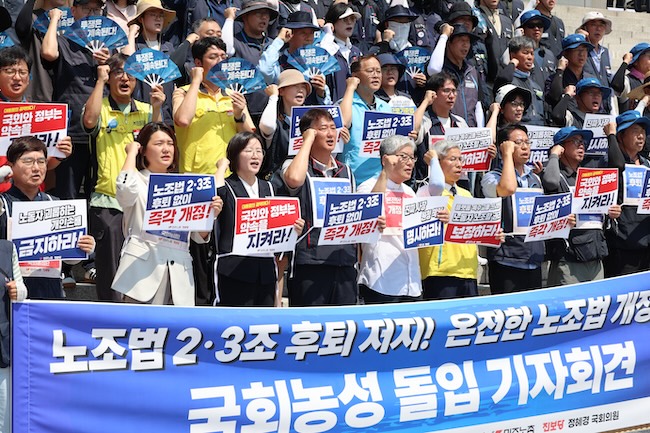
The legislation, led by the ruling Democratic Party, aims to amend Articles 2 and 3 of the Trade Union and Labor Relations Adjustment Act to expand the legal definition of “employer” and broaden union bargaining rights. (Image courtesy of Yonhap)
SEOUL, July 30 (Korea Bizwire) — Foreign companies operating in South Korea are voicing strong opposition to the so-called “Yellow Envelope Law,” warning it could significantly raise legal risks and operational burdens — with some even suggesting they may reconsider their presence in the country if the bill passes.
The legislation, led by the ruling Democratic Party, aims to amend Articles 2 and 3 of the Trade Union and Labor Relations Adjustment Act to expand the legal definition of “employer” and broaden union bargaining rights. The bill is scheduled for a vote on August 4 in the final plenary session of the National Assembly’s July term.
In a rare public statement, the European Chamber of Commerce in Korea (ECCK) — which represents over 400 European companies including BMW, Mercedes-Benz, Lufthansa, and AB InBev — warned that the proposed amendments could “turn business leaders into potential criminals” by broadly expanding employer liability to include firms with indirect or no contractual employment ties to workers.
The most contentious change would redefine “employer” to include companies with substantial influence over working conditions — such as original contractors in multi-tier supply chains — even if no direct employment relationship exists. This could expose major firms to mandatory bargaining obligations with subcontractors, dispatch workers, and other non-regular labor groups.
Foreign manufacturers, which often operate via complex subcontracting structures in Korea, say the expanded scope would open the floodgates to legal ambiguity and compliance risk. AB InBev, which owns South Korean beer giant OB, has already faced disputes with subcontracted logistics workers demanding direct accountability from the parent firm.
“The Yellow Envelope Law could further intensify Korea’s already rigid labor environment,” said an executive from a U.S.-based firm who spoke on condition of anonymity. “Hiring, firing, and wage adjustments would become even more complex.”
The American Chamber of Commerce in Korea (AMCHAM) is also expected to release a statement as early as July 30. Last year, AMCHAM warned the law would undermine South Korea’s attractiveness as an investment destination by destabilizing its business environment.
A recent survey by the Federation of Korean Industries (FKI) found that 57% of foreign-invested companies in South Korea view the country’s labor relations as adversarial. About 13% have considered scaling down or exiting due to increasingly restrictive labor regulations.
Despite mounting criticism from international business groups, the Democratic Party remains committed to pushing the bill through. The law has twice passed the National Assembly in previous sessions, only to be vetoed by former President Yoon Suk-yeol.
With the APEC Summit approaching and economic stability under scrutiny, the outcome of this legislative battle could send strong signals about South Korea’s direction on labor reform — and its appeal to global investors.
M. H. Lee (mhlee@koreabizwire.com)