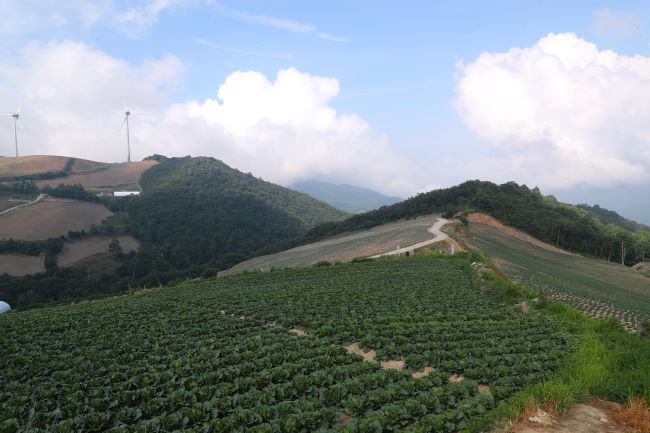
The alpine cabbage fields of Anbandegi in Gangwon Province. (Image courtesy of Yonhap)
Highland growers in Gangwon face mounting losses as warming temperatures and extreme weather push summer cabbage to the brink
GANGNEUNG, August 5 (Korea Bizwire) — Once known for its cool summer breezes and starlit skies, the alpine cabbage fields of Anbandegi in Gangwon Province—South Korea’s largest high-altitude farming zone—are now at the frontline of climate change.
Farmers in this mountainous region, situated 1,100 meters above sea level, are witnessing firsthand the toll of a warming climate. Once ideal for cultivating summer napa cabbage—a key ingredient in Korean cuisine—these fields are suffering from rising temperatures, erratic rainfall, and persistent drought.
The result: shriveled crops, diseased leaves, and growing uncertainty about the future of a centuries-old farming tradition.
“Farming these days is just looking up at the sky and hoping,” said a 78-year-old farmer in Anbandegi, lamenting this year’s poor harvest. “At this rate, we may not be able to grow summer cabbage here anymore.”
Cabbage, a cool-weather crop, requires large day-night temperature swings and steady moisture to form its dense, crisp heads. But warming summer nights and unpredictable downpours have disrupted that balance, causing what farmers call “hollow cabbages” and fueling the spread of crop diseases like wilt and cyst nematodes.
Other famed highland regions—such as Taebaek, Samcheok, Pyeongchang, and Jeongseon—are facing similar challenges, as farmers retreat from lands once considered prime for cultivation. A growing number are giving up entirely, citing rising soil-borne pests and crop failure risks.
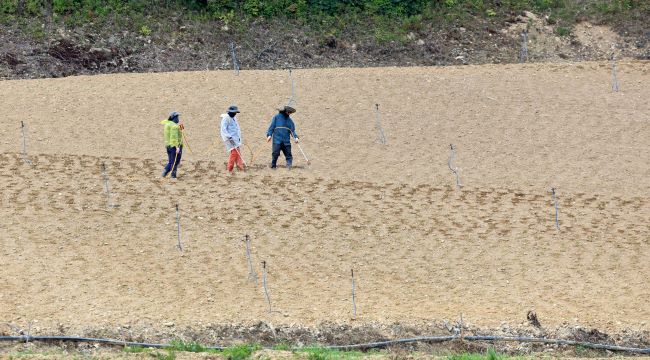
the alpine cabbage fields of Anbandegi in Gangwon Province—South Korea’s largest high-altitude farming zone—are now at the frontline of climate change. (image courtesy of Yonhap)
The threat is not merely anecdotal. A report submitted to the National Assembly by the Rural Development Administration last year projected that by the 2050s, only 3% of currently viable alpine cabbage farmland will remain suitable. By the 2090s, that number could fall to just 0.3%.
These estimates assume current cultivation methods and crop varieties remain unchanged—underscoring the urgency for innovation.
In response, the government is stepping in with both emergency and long-term measures. The Korea Agro-Fisheries & Food Trade Corporation (aT) has begun purchasing 4,000 tons of cabbage from Gangwon’s highland regions to stabilize supply amid heatwaves and flooding.
Meanwhile, the Rural Development Administration has established a dedicated Highland Cabbage Research Division tasked with breeding resilient varieties and developing pest control and soil management techniques.
“This is a critical time for preemptive action,” said Lee Young-kyu, head of the research unit. “Even the highlands are getting warmer, and farmers are facing challenges they’ve never seen before.”
While short-term interventions may ease supply disruptions, experts warn that without aggressive adaptation and climate-resilient agricultural strategies, Korea’s highland cabbage—an essential part of the nation’s food culture—could become a rare seasonuxury within a generation.
M. H. Lee (mhlee@koreabizwire.com)