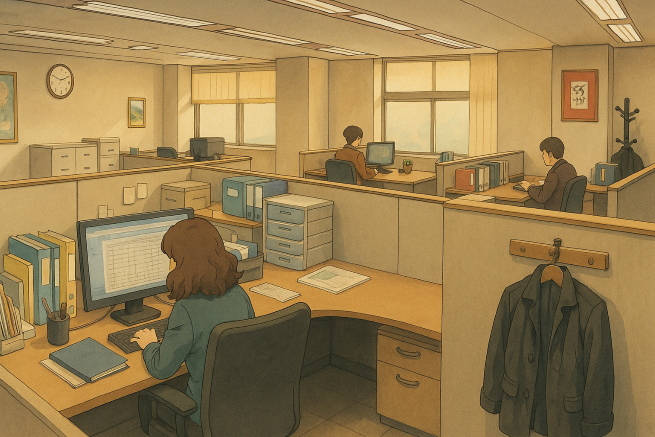
Under the plan, businesses with fewer than five employees—currently exempt from key labor laws—would gradually come under the coverage of the Labor Standards Act and the Industrial Safety and Health Act. (Image supported by ChatGPT)
SEOUL, Aug. 13 (Korea Bizwire) — South Korea’s Presidential Committee on National Planning unveiled Wednesday a comprehensive set of labor policy initiatives that would extend protections to the country’s smallest workplaces and strengthen rights for all workers.
The proposals are part of President Lee Jae Myung’s broader agenda for his term, aimed at modernizing the nation’s labor framework and improving workplace safety.
Under the plan, businesses with fewer than five employees—currently exempt from key labor laws—would gradually come under the coverage of the Labor Standards Act and the Industrial Safety and Health Act.
Workers in these microenterprises, who now lack protections such as the 52-hour workweek, overtime and holiday pay, and safeguards against workplace harassment, would begin to receive incremental benefits starting later this year.
By 2027, the reforms aim to extend paid leave, alternative holidays, and annual vacation entitlements to small business employees. The plan also includes provisions for ultra-short-hour workers—those working under 15 hours per week—to gain access to the four major social insurance programs, retirement pay, and weekly holiday pay by 2028.
The committee also announced a push to establish a new framework for nonstandard work, covering platform, freelance, and special-contract workers. A proposed “worker presumption” system would clarify eligibility for labor protections, while plans to convert high-risk, long-term nonregular jobs into permanent positions would resume in the second half of next year.
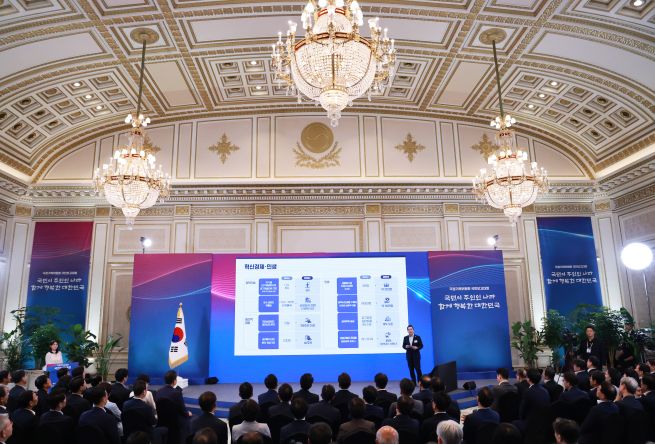
Park Hong-geun, head of the National Policy Planning Division of the Presidential Committee on National Policy Planning, is delivering a presentation at the National Policy Planning Committee’s public report event held at the Blue House’s State Guesthouse on August 13. (Yonhap)
Additional initiatives include a phased rollout of mandatory retirement pensions, targeting all companies by 2030, and a codification of the principle of “equal pay for work of equal value” in the Labor Standards Act. Minimum wage measures for freelancers and platform workers are set to begin in early 2027.
To reduce the country’s extensive work hours, the government intends to pursue a four-and-a-half-day workweek and cut annual statutory labor hours to the OECD average of roughly 1,700 hours. A nationwide “real working hours reduction roadmap” will be implemented next year, supported by new local government mandates and funding measures to ensure compliance.
Workplace safety reforms are also central to the agenda. South Korea aims to reduce industrial accident fatalities to the OECD average by 2030, expanding safety regulations to cover microbusinesses, special contractors, platform workers, and freelancers.
Plans include an annual safety reporting requirement, a state-backed accident compensation system, and universal workers’ accident insurance.
Other provisions include banning blanket wage systems that obscure overtime pay, guaranteeing workers the right to disconnect outside work hours, automatic parental leave initiation, childcare allowances for self-employed workers, and the gradual extension of the retirement age starting in 2028.
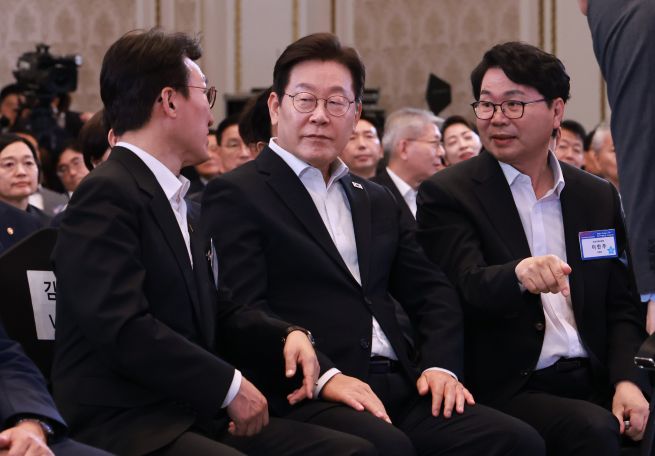
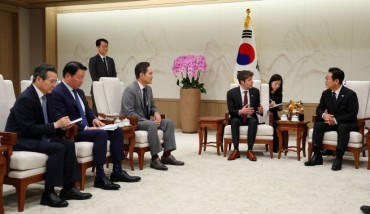
President Lee Jae-myung speaks with Prime Minister Kim Min-seok at the National Policy Planning Committee’s public briefing held at the Blue House State Guesthouse on Wednesday. On the right is Lee Han-joo, chairman of the committee. (Yonhap)
Policies for migrant workers would be strengthened, including a new integrated support roadmap and adjustments to the E-9 employment permit system to allow greater job mobility and long-term employment stability.
The committee also floated symbolic measures, such as renaming “Labor Day” to “Workers’ Day,” promoting cross-company collective bargaining, and establishing a specialized labor court.
The plan reflects an ambitious effort to modernize South Korea’s labor market while aligning workplace standards more closely with OECD norms, particularly in protecting vulnerable workers and improving occupational safety.
M. H. Lee (mhlee@koreabizwire.com)