Nurses are caring for newborns in the neonatal unit at Ilsan CHA Hospital. (Image courtesy of Yonhap)
SEOUL, Aug. 15 (Korea Bizwire) — Young South Koreans weigh more factors — and express greater concerns about economic strain and lost opportunities — when deciding whether to have children than their counterparts in Germany, Japan, France and Sweden, a new study shows.
They are also more likely to perceive their society as unfair and to find balancing work and family life difficult.
The Korea Institute for Health and Social Affairs surveyed 2,500 adults aged 20 to 49 in each of the five countries between June and September last year.
While all nations face declining birthrates, South Korea’s fertility rate stands at just 0.75, the lowest in the group and well below the others’ rates in the 1.0 range.
Despite this, South Koreans who are unmarried expressed the highest willingness to marry, at 52.9 percent, compared with 50.2 percent in Sweden and 32 percent in Japan.
But only 31.2 percent of South Koreans expressed a willingness to have children, far behind Sweden’s 43.2 percent and France’s 38.8 percent.
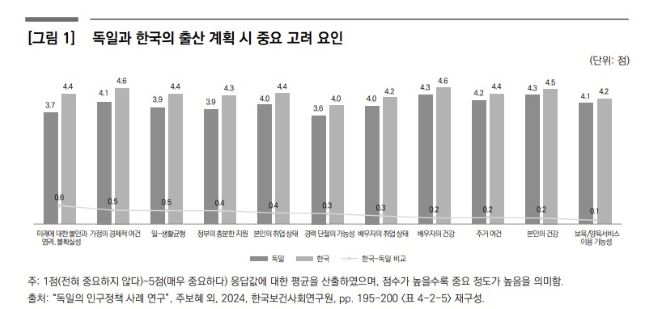 Among those planning children, South Koreans envisioned the smallest families — an average of 1.74 children, versus more than two in Germany, Sweden and France.
Koreans rated every consideration for having children — from household finances and housing to potential career disruption — as more important than did peers elsewhere.
More than half (50.1 percent) cited “future uncertainty” as a major factor, compared with 30.5 percent in Japan and 22.5 percent in Sweden.
Nearly 60 percent strongly agreed that children bring substantial financial burdens, far exceeding the shares in France, Japan and Sweden.
They were also the most likely to say that having children would reduce personal freedom or job opportunities for themselves or their spouses, and the most likely to find combining work, housework and child-rearing difficult.
Only 2.35 out of 5 agreed their society is generally fair, the lowest score among the countries surveyed.
The report concluded that attitudes toward marriage, childbirth and parenting are shaped less by personal choice than by structural conditions such as work-life balance, career stability and the effectiveness of public policy.
It urged future population measures to address these broader social frameworks.
M. H. Lee (mhlee@koreabizwire.com)