On the morning of August 20, at the southern end of Tongil Bridge in Paju, Gyeonggi Province, unrepentant long-term prisoner Ahn Hak-seop (center), who is demanding repatriation to North Korea, holds up a North Korean flag. (Yonhap)
PAJU, Aug. 20 (Korea Bizwire) — A 95-year-old former long-term prisoner of war, An Hak-seop, attempted on Wednesday to cross into North Korea through Panmunjom but was stopped by South Korean military authorities at the Tongil Bridge checkpoint.
An, who has long identified as a “non-converted” prisoner for refusing to renounce allegiance to the North, traveled by car with supporters from Imjingang Station to the southern end of Tongil Bridge in Paju, Gyeonggi Province.
Leaning on a cane and aided by activists, he tried to walk toward the checkpoint around 11:40 a.m. but was blocked by guards for lacking prior authorization.
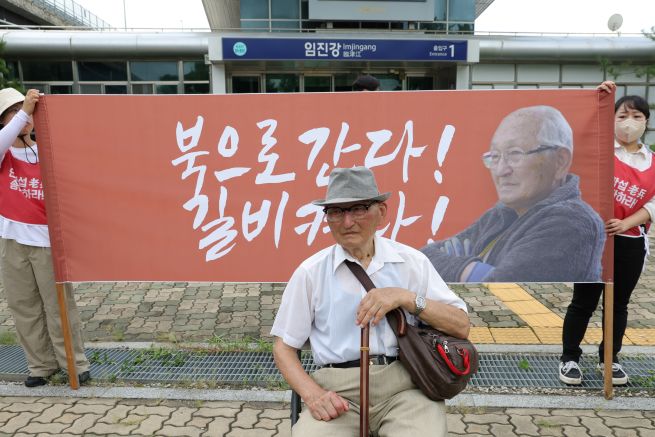
On the morning of August 20, at Imjingang Station in Paju, Gyeonggi Province, unrepentant long-term prisoner and former war prisoner Ahn Hak-seop is seen deep in thought ahead of moving toward Tongil Bridge during a rally calling for his repatriation. (Yonhap)
Under South Korean law, access to the Demilitarized Zone and Panmunjom requires military and United Nations approval. Unauthorized entry can result in prosecution under the Military Bases and Installations Protection Act.
Roughly ten minutes later, An turned back, waving a North Korean flag before being taken by ambulance to a hospital due to health issues. Earlier at a rally, he had denounced decades of imprisonment, alleging torture and mistreatment for refusing to sign a renunciation statement.
An, born on Ganghwa Island, joined North Korean forces during the 1950–53 Korean War. Captured in 1953, he served 42 years in prison before his release in 1995. While 63 other non-converted prisoners were repatriated to the North in 2000 under the Kim Dae-jung administration following the June 15 inter-Korean summit, An chose to remain in the South, vowing to continue his struggle against U.S. forces.
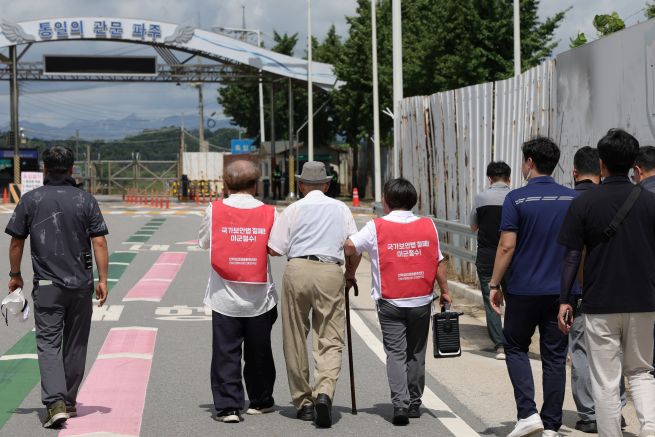
On the morning of August 20, at the southern end of Tongil Bridge in Paju, Gyeonggi Province, unrepentant long-term prisoner Ahn Hak-seop (center), who is demanding repatriation to North Korea, heads toward a checkpoint. (Yonhap)
His supporters argue that, as a prisoner of war, An has the right to return to his homeland. “A POW should always be able to return to his country,” said Rev. Lee Jeok, a co-leader of the support group. “Blocking him is unjust.”
No repatriations of non-converted prisoners have taken place since the 2000 exchange, and only five or six survivors are believed to remain. South Korean authorities, while ruling out immediate repatriation, said they are reviewing “various options” regarding their status.
M. H. Lee (mhlee@koreabizwire.com)