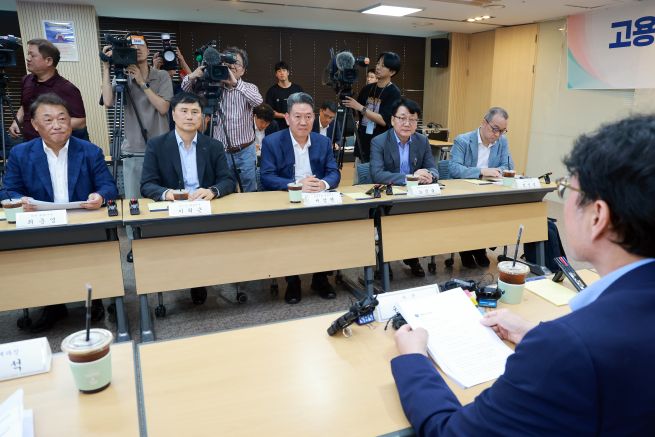
Vice Minister of Employment and Labor Kwon Chang-jun speaks on August 21 at a meeting with CEOs from the steel, shipbuilding and automobile industries at the Seoul Regional Employment and Labor Office in Jung District, Seoul, regarding the amendments to Articles 2 and 3 of the Trade Union and Labor Relations Adjustment Act (Yellow Envelope Law), as Kia CEO Choi Joon-young (from left), POSCO CEO Lee Hee-keun, Hyundai Steel CEO Seo Kang-hyun, HD Hyundai Heavy Industries CEO Noh Jin-yul, and Hanwha Ocean President Jung In-sub listen. (Yonhap)
SEOUL, Aug. 24 (Korea Bizwire) — South Korea’s business community reacted with alarm on Sunday after the National Assembly, led by the Democratic Party, passed the so-called Yellow Envelope Law, a sweeping revision to labor legislation that broadens the definition of strikes and limits corporate damage claims against workers.
Six of the country’s largest business lobbies — including the Korea Employers Federation, the Korea Chamber of Commerce and Industry and the Federation of Korean Industries — issued a joint statement expressing “deep regret” over the vote, warning that the new rules could deal a severe blow to management autonomy and the competitiveness of Korean industry.
They called on lawmakers to quickly introduce supplementary measures to clarify the law’s scope and minimize disruption.
The legislation expands the range of disputes that can be classified as legal strikes, makes parent companies more accountable for subcontractor conflicts and curtails the ability of employers to seek large-scale compensation for losses caused by walkouts.
Business leaders argue the law will invite constant litigation in industries with sprawling supply chains — such as automobiles, shipbuilding and steel — while leaving companies to shoulder costs even in cases of illegal union activity.

Union representatives celebrating the passage of the Yellow Envelope Law (Yonhap)
Executives voiced particular concern that management decisions on restructuring, relocation and investment — once seen as outside the scope of labor disputes — could now become targets of industrial action.
“Virtually every management decision affects working conditions, meaning almost any issue could become grounds for a strike,” one corporate executive said, calling the law a restriction on employers’ constitutional rights.
Some warned the legislation could accelerate the departure of foreign firms, already uneasy about Korea’s labor climate. The American Chamber of Commerce cautioned that the law could “impose excessive liability on parent companies and increase legal uncertainty.”
GM Korea, one of the country’s largest foreign investors, has privately raised the possibility of a reassessment of its Korean operations.
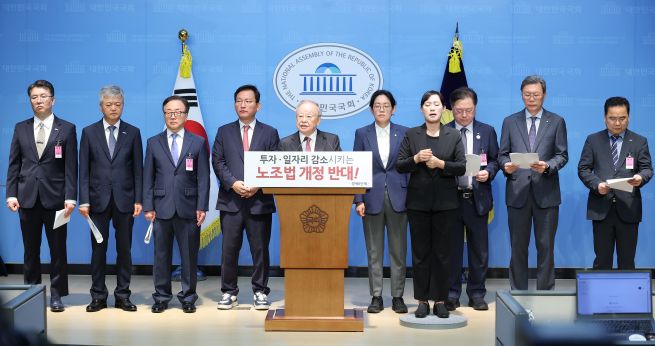
The six major business associations urged that supplementary legislation must follow to minimize the fallout from the Yellow Envelope Law (Yonhap)
Industry leaders urged lawmakers to extend the law’s six-month grace period to at least a year, arguing companies need more time to prepare. “The biggest fear is that businesses will quietly leave,” said one senior executive. “If this law leads to mounting cases of corporate strain, both foreign and domestic companies will inevitably rethink their presence in Korea.”
The government has pledged to consult with industry during the transition, but corporate leaders say the Yellow Envelope Law represents one of the most consequential shifts in South Korea’s labor relations in decades — and one that could reverberate across its economy.
Ashley Song (ashley@koreabizwire.com)