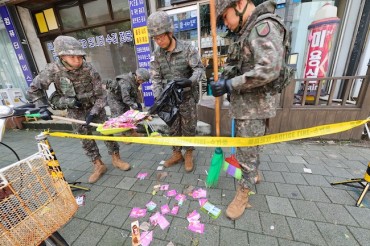
2025 Busan job fair for international students. (Image courtesy of Yonhap)
SEOUL, Aug. 27 (Korea Bizwire) — Despite government hopes that international students could help ease labor shortages in South Korea’s manufacturing sector, a new study suggests that most foreign graduates are reluctant to remain in the country for the long haul.
According to a report released Tuesday by the Korea Immigration Policy Research Institute, only 18.6 percent of foreign workers who earned degrees in South Korea said they wished to settle permanently.
That figure falls well short of the 31.5 percent recorded among foreign workers with degrees earned abroad.
The survey of 348 foreign workers found further contrasts in medium-term intentions. Among degree-holders educated in Korea, 27.9 percent said they wanted to stay five to ten years, compared with 44.9 percent of those with overseas degrees.

Future Residency Intentions in Korea Among Domestic and International Degree Holders . (Image courtesy of Korea Immigration Policy Institute)
By contrast, more than half of Korea-educated graduates — 53.5 percent — said they intended to leave within five years, more than double the share of their overseas-educated peers.
The findings suggest that many international students who enter South Korea’s small and midsize manufacturers do so temporarily, aiming to gain skills or work experience before returning home or moving on to third countries.
Language barriers and mismatched job conditions appear to be major deterrents. Roughly one in three Korea-educated respondents cited poor Korean proficiency as a challenge in job-hunting, while another 30 percent pointed to misaligned job requirements.
Only 3.9 percent said they faced no obstacles — compared with nearly 20 percent among foreign workers with overseas degrees.
Both groups placed the highest priority on wages when choosing a job. Yet the study also found that Korea-educated graduates were more likely to be employed in repetitive, low-skill positions: 46.5 percent reported working in simple manual roles, compared with 31.8 percent of their overseas-educated counterparts.
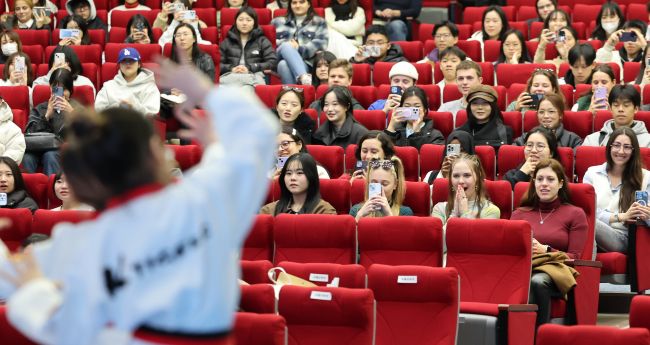
On May 28, international students attending the 2025 spring semester orientation at the university theater of the Daeyeon Campus of Pukyong National University in Nam-gu, Busan, enjoy a Taekwondo demonstration. (Image courtesy of Yonhap)
The institute concluded that current government policy, which encourages foreign graduates of Korean universities to join local manufacturers, has limited effectiveness.
It urged the creation of degree programs tied to regional industries and expanded access to vocational training for foreign workers.
M. H. Lee (mhlee@koreabizwire.com)