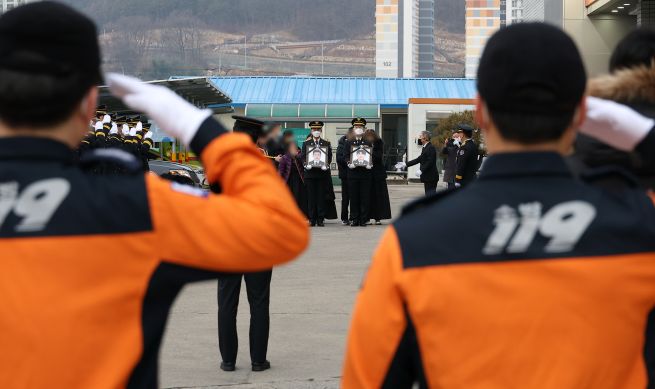
Fellow firefighters salute in honor of their fallen colleague, paying final respects (Yonhap)
SEOUL, Aug. 31 (Korea Bizwire) — Nearly three years after the deadly crowd crush in Seoul’s Itaewon district, the toll on firefighters who rushed to the scene continues to reverberate.
A growing number of first responders have died by suicide, prompting urgent calls for stronger measures to address post-traumatic stress disorder (PTSD) among emergency personnel.
Firefighters describe searing memories: victims pulled from car crashes with faces mangled, bodies burned in arson cases, or the chaos of Itaewon’s packed alleyways where hundreds suffocated.
“The scene was a living hell,” said Cho Yong-woon, a fire captain at Incheon Fire Academy who responded that night. Others recall traumatic encounters in earlier decades when no psychological support was available.
Experts warn PTSD among first responders can be more debilitating than schizophrenia, leading to severe depression, anxiety, and social withdrawal. “These symptoms can erode daily life, relationships, and work capacity,” said Park Jong-ik, professor of psychiatry at Kangwon National University.
The scale of the problem is stark. According to the National Trauma Center, more than 1,300 firefighters who responded to Itaewon received psychological assistance in the year following the disaster, but only a fraction continued with in-depth treatment.
Firefighters’ unions say piecemeal counseling and voluntary programs are insufficient, demanding mandatory, long-term mental health care.
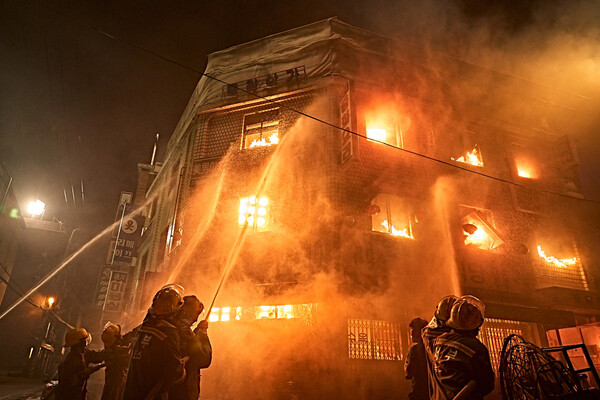
Poster for the film The Firefighter, released on December 4, 2024 (Image provided by BY4M).
Some firefighters admit they still suffer flashbacks when passing accident sites or even counseling centers. Others grapple with survivor’s guilt after colleagues took their own lives. A firefighter union leader described how new recruits once relied only on grim advice from veterans: “Never meet the eyes of the dead.”
Specialists say systemic reform is overdue. “The occupation itself guarantees repeated trauma exposure,” said Park. “We need structured screening, early intervention, and stronger commitment from fire service leadership.”
The National Fire Agency says it is expanding anonymous treatment subsidies and preparing to open a dedicated mental health center at the forthcoming National Fire Hospital next year. A firefighter wellness retreat is also planned in Gangneung by 2028.
But for many on the front lines, the reforms come too late. “These scars don’t fade with time,” said one veteran. “Without real treatment, we just carry them until they break us.”
Lina Jang (linajang@koreabizwire.com)