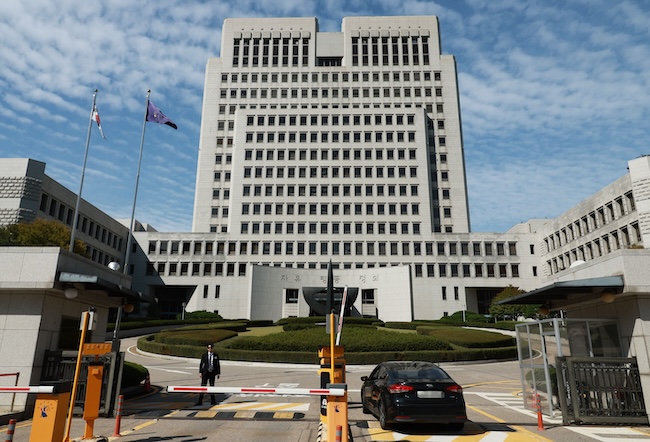
The Supreme Court (Image courtesy of Yonhap)
SEOUL, Sept. 6 (Korea Bizwire) — South Korea’s judiciary is bracing for what many judges describe as the most sweeping attempt at judicial reform in decades, as the Supreme Court moves to gather the views of court leaders nationwide ahead of legislation being advanced by the ruling Democratic Party.
The Supreme Court announced that it will convene an emergency meeting of all chief judges on Sept. 12 at its Seoul headquarters, an unusual step reflecting what officials called an “extraordinary situation.” Traditionally, such gatherings are held twice a year; the decision to call an interim session underscores the urgency inside the judiciary.
At issue are reform bills that Democrats hope to push through the National Assembly before the Chuseok holiday. Proposals include doubling the number of Supreme Court justices from 14 to 30, altering the nomination process, expanding public access to lower court rulings, tightening rules on search warrants, and introducing a formal evaluation system for judges.
Justice Cheon Dae-yeop, head of the National Court Administration, has already conveyed concerns to lawmakers, warning that a rapid expansion of the high court would drain resources from trial courts and weaken fact-finding.
He also questioned plans to diversify the nominating committee, criticized judicial evaluation schemes as incompatible with judicial independence, and stressed that such structural changes require formal consultation with the bench.
While the Supreme Court has traditionally expressed views through its administrative arm rather than as an institution, legal observers say this week’s meeting could mark the first time the judiciary issues a collective, formal response to the reform drive. The court’s position, once consolidated, is expected to carry significant weight in the political debate.
The confrontation highlights mounting tensions between the judiciary and President Lee Jae-myung’s Democratic Party, which has cast its reform package as essential for transparency and public trust. Judges, however, argue that pushing through changes without broad judicial participation risks undermining the separation of powers.
As the storm over what commentators are calling the “Yeouido-style judicial reform typhoon” gathers strength, both lawmakers and the courts appear headed for a defining clash over the future of South Korea’s judicial architecture.
M. H. Lee (mhlee@koreabizwire.com)