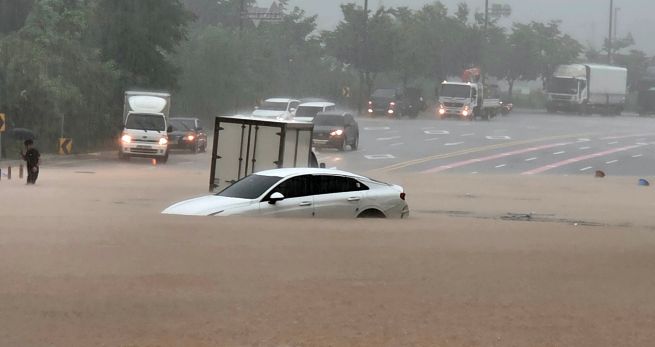
On August 13, as sudden heavy rain hit the Seoul metropolitan area, a driver escaped from a car that became flooded on Hwarang-ro in Deogyang District, Goyang, Gyeonggi Province. (Photo provided by a reader)
SEOUL, Sept. 9 (Korea Bizwire) — South Korea’s central bank has warned that failing to act decisively on climate change could leave the nation facing prolonged inflationary pressures as extreme heat and heavy rainfall increasingly disrupt prices.
In a report released Monday, the Bank of Korea found that a one-degree Celsius “heat shock,” defined as the gap between average monthly temperatures and actual daily highs, pushed consumer prices up by an average of 0.055 percentage points over 24 months.
Similarly, rainfall exceeding the monthly average by 10 millimeters drove inflation 0.033 points higher for more than 15 months.
The effects intensified sharply under extreme conditions. When temperatures ranked in the top 5 percent of historical records, each additional degree raised inflationary pressure by 0.11 points over a year — nearly double the usual effect. Likewise, extreme rainfall events boosted inflation by 0.054 points on average.
“The impact of weather shocks grows nonlinearly once they pass certain thresholds,” said Yeon Jeong-in, head of the central bank’s Sustainable Growth Division.
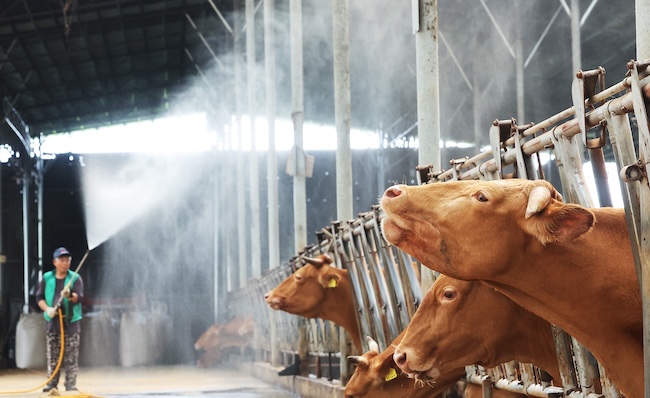
Cattle cool off under a spray of water from a farmer in the city of Hwaseong, Gyeonggi Province, on July 30, 2025, amid extreme heat waves. (Image courtesy of Yonhap)
Looking ahead, the report projected that without stronger climate adaptation, South Korea could see average peak summer temperatures rise to 42.2°C by the end of the century — 22.7 percent higher than today.
In that scenario, weather-driven inflationary pressure could more than double, reaching 0.73 to 0.97 percentage points annually between 2051 and 2100.
The bank urged increased investment in climate adaptation, particularly in agriculture, fisheries and other vulnerable sectors, and called for an early-warning monitoring system to track weather’s impact on prices.
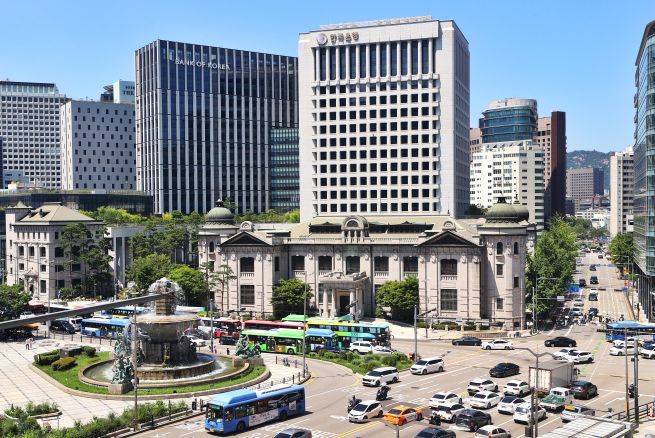
The headquarters of the Bank of Korea in Jung District, Seoul. (Image courtesy of Yonhap)
It also recommended expanding research on how extreme climate events could affect the broader economy and complicate monetary policy.
The findings underscore how climate volatility is moving from an environmental risk to a central economic challenge — one that could complicate price stability well into the next century.
M. H. Lee (mhlee@koreabizwire.com)