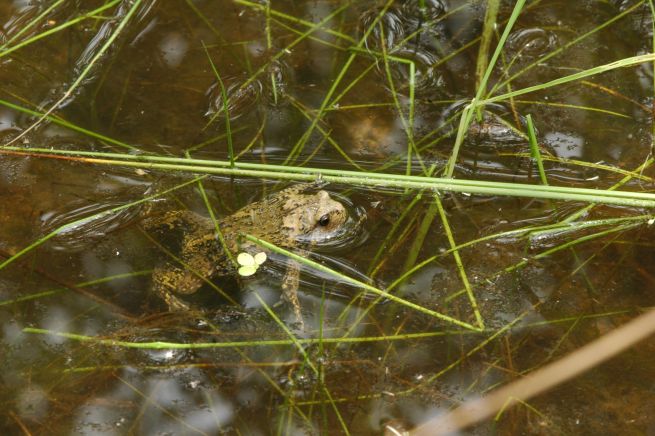
The Mongkoi is considered one of the key variables in land development projects. As a Class II endangered species designated by the Ministry of Environment, any discovery of Mongkoi within a development zone requires that they be strictly preserved. (Photo courtesy of Seoul Metropolitan Government)
SEOUL, Sept. 15 (Korea Bizwire) — When South Korea announced its latest housing policy this month, officials were not only grappling with soaring property prices and supply shortages in the Seoul metropolitan area. They were also contending with a tiny, nocturnal amphibian with outsized influence: the Mongkoi.
The Mongkoi (also known as narrow-mouth frog), listed as a class-II endangered species by the Ministry of Environment, has long been a thorn in the side of urban planners. Whenever the toadlike creature is discovered on a construction site, work is forced to stop while biologists are called in to trap, count, and move them—sometimes tens of thousands at a time.
“People may laugh at the idea that such a small animal could delay a multi-billion-won housing project,” said an environmental consultant who works on new town developments. “But once a Mongkoi is found, you can’t just ignore it. The law is clear.”
A New Approach
The government’s September 7 housing package included what officials are calling a “fast-track Mongkoi relocation plan.” For the first time, developers will be allowed to establish alternative habitats outside project zones, enabling a one-time transfer instead of the current two-stage process, which can stretch on for months.
Traditionally, Mongkoi are first moved into temporary holding wetlands within the same development zone. Only after permanent ecological parks or man-made wetlands are completed are they captured again and moved once more. The system is designed to keep them close to their original homes, but it often results in stress, injury, and population decline.
By contrast, an external habitat allows developers to shorten the timeline and reduce the amphibians’ exposure to repeated captures. “We believe this is not only more efficient but also healthier for the Mongkoi,” a Ministry of Land official said.
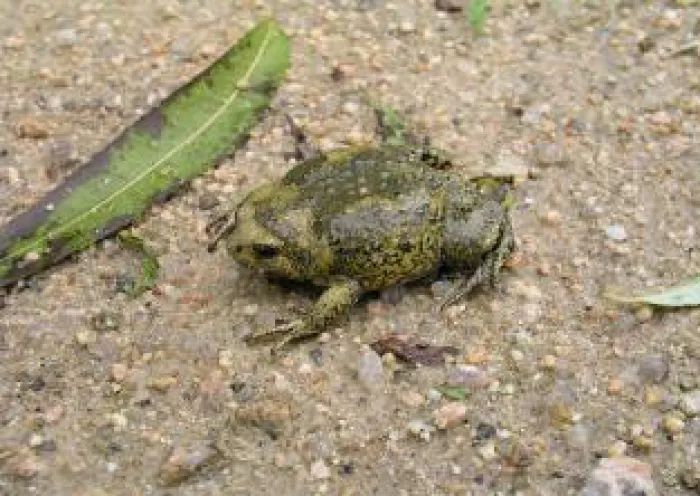
The Mongkoi is an amphibian whose population has sharply declined due to reckless development and climate change. In 2005, the Ministry of Environment designated it as an endangered species. Because it can only breed in limited environments such as shallow wetlands or temporary ponds, it is considered highly vulnerable to human activity.
Housing Pressure vs. Conservation
The compromise comes at a time when South Korea faces mounting housing pressures. The government has promised to accelerate supply in the capital region, including large-scale “third new town” developments. Delays caused by environmental hurdles have become a flashpoint in the broader debate over housing affordability, which has emerged as one of the Lee Jae-myung administration’s most sensitive political challenges.
“Balancing environmental protection with development isn’t optional anymore—it’s essential,” said a policy analyst at the Korea Research Institute for Human Settlements. “The Mongkoi is a symbol of that dilemma. Every delay costs money, but every shortcut risks biodiversity loss.”
A Toad With Outsized Influence
Unlike many endangered species, Mongkoi are not especially rare. In fact, biologists say thousands can be found in a single development zone. Their resilience is part of the problem: the more numerous they are, the more difficult and time-consuming the relocation becomes.
Developers recount stories of work crews halted mid-bulldoze as researchers scrambled to scoop Mongkoi into buckets. “We thought the project was ready to break ground,” said one construction manager in Goyang. “Then the Mongkoi showed up, and everything stopped.”
The creatures, known for their croaking calls after summer rains, have become so integral to the development process that industry insiders joke about “Mongkoi risk” when estimating project timelines.
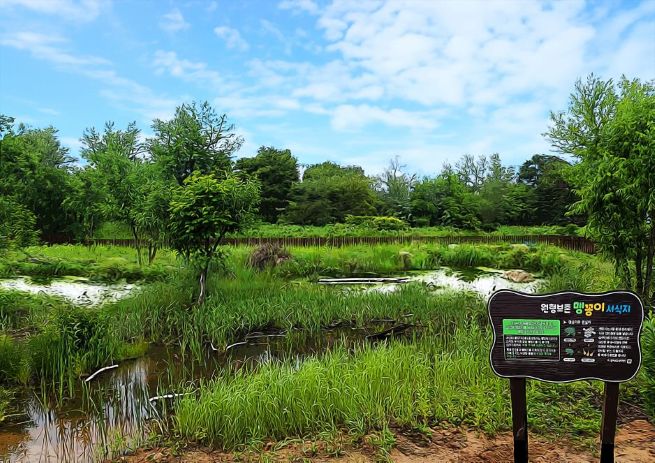
Mongkoi wetland (Photo courtesy of Seoul Metropolitan Government)
Seeking Common Ground
The new policy does not remove protections for the amphibians. Environmental groups have long argued that the animals’ presence signals healthy wetlands, which should be preserved rather than paved over. In some cases, developers have struck unusual partnerships with conservation agencies, using royal tombs, riversides, or forest clearings as designated Mongkoi sanctuaries.
In 2021, the Korea Land and Housing Corporation signed an agreement with the Korea Heritage Service to use forested areas around royal tombs as relocation sites. “It’s a reminder,” said an environmental historian, “that even in the rush for housing, South Korea is trying to reconcile development with cultural and ecological preservation.”
The Broader Lesson
Officials estimate that the streamlined relocation system, combined with other regulatory adjustments, could shorten project timelines by at least six months. But the episode also underscores a deeper reality: the challenges of growth in a country that has already urbanized much of its landscape.
“In the 1970s, we built first and worried later,” said a retired urban planner. “Today, we are forced to consider the Mongkoi. It shows how much our society has changed.”
For residents waiting for affordable housing, the amphibian may look like yet another bureaucratic hurdle. For environmentalists, it represents the survival of a fragile ecosystem in the shadows of Seoul’s endless sprawl.
Somewhere between the two, the Mongkoi croaks on, unwittingly shaping the future of South Korea’s cities.
M. H. Lee (mhlee@koreabizwire.com)