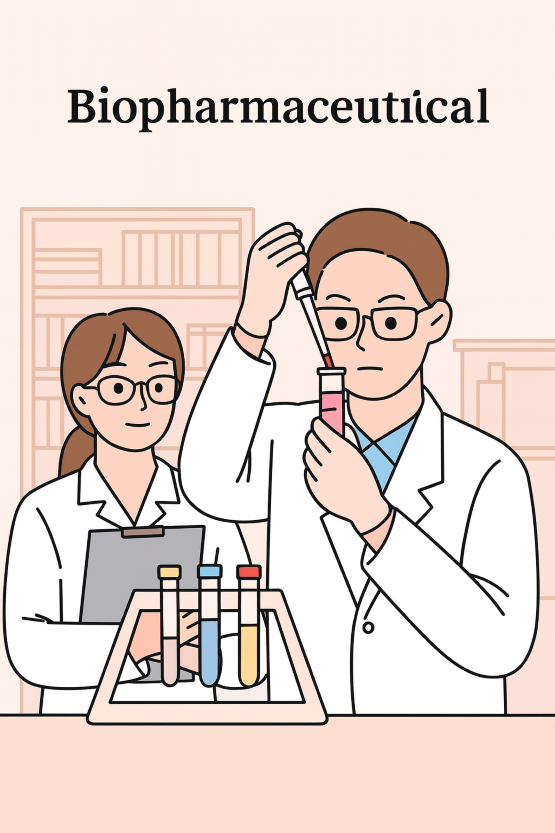
A biosimilar is a copy of an original biopharmaceutical whose patent has expired. It has nearly the same efficacy as the original drug but is typically more than 30 percent cheaper. Biosimilars are replicas of biopharmaceuticals, which are produced using living cells such as animal cells, yeast, or E. coli to create high-molecular protein products. (Image supported by ChatGPT)
SEOUL, Sept. 29 (Korea Bizwire) — South Korea’s biosimilar industry is ramping up competition at home and abroad, with companies racing to secure early approvals, expand sales networks, and leverage artificial intelligence as differentiators in a crowded market.
At least six biosimilars won approvals or launches globally this month alone, underscoring the pace of expansion. Celltrion secured Canadian approval for Stovoclo-Osenbelt (for bone disorders), Japanese approval for Aptozma (autoimmune diseases), and European clearance for Omriclo (urticaria).
It also launched Stekima and Omriclo in Australia. Samchundang Pharm obtained domestic approval for its eye-disease treatment Vizenfree and signed supply deals across eight Eastern European countries for its Eylea biosimilar. Alteogen, another Korean firm, won European approval for Iluxvi, an Eylea rival.
New players are also entering the fray. Daewoong Pharmaceutical, a traditional drugmaker, announced its entry into biosimilars by recruiting a Celltrion veteran to lead the business.
Industry analysts say the battle increasingly hinges on first-mover advantage. Early entrants can lock in patients and insurers, set pricing benchmarks, and establish themselves as the “reference biosimilar,” shaping long-term revenue streams.
Celltrion’s Remsima, the world’s first monoclonal antibody biosimilar, exemplifies this strategy: it surpassed ₩1 trillion ($740 million) in global sales last year and captured more than half of the European market in 2017.
This undated file photo shows the sign of South Korea’s pharmaceutical giant Celltrion Inc. (Image courtesy of Yonhap)
Distribution networks are another critical front. Samsung Bioepis partnered with U.S. ophthalmology specialist Harrow to commercialize its eye-disease drugs Byooviz and Opuviz, while Celltrion has expanded direct sales operations in Europe, the United States, and Switzerland. Dong-A ST is working with Intas and Accord Biopharma to sell Imuldosa in the U.S. at steep discounts to J&J’s Stelara.
Artificial intelligence is also emerging as a strategic tool. Executives, including Celltrion Chairman Seo Jung-jin, have pledged AI investments to cut costs and boost clinical trial success rates.
With approvals accelerating, Korean biosimilar firms are positioning not just as fast followers but as global leaders — seeking to define pricing, distribution, and innovation in one of the pharmaceutical industry’s fastest-growing markets.
Ashley Song (ashley@koreabizwire.com)

![[Kobiz Feature] “Hanbok” Slowly Regains Its Former Glory](http://koreabizwire.com/wp/wp-content/uploads/2013/11/4789085815_02d601f899_o-370x383.jpg "[Kobiz Feature] “Hanbok” Slowly Regains Its Former Glory")