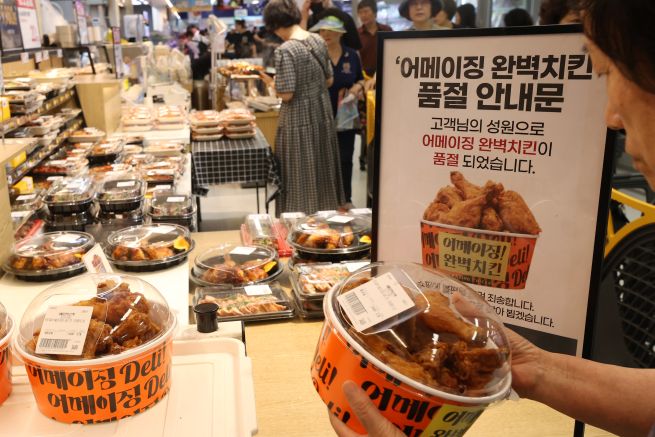
On July 6, a shopper exchanges a numbered ticket for fried chicken at an E-Mart store in Seoul. The retailer drew strong consumer response by offering its “Amazing Perfect Chicken,” made with 100 percent domestically sourced fresh chicken, for 3,480 won (one per customer) through that day. (Yonhap)
SEOUL, Oct. 12 (Korea Bizwire) — Once a symbol of comfort and affordability, fried chicken has become an expensive indulgence for many South Koreans, as soaring prices trigger public frustration and social media backlash over what consumers are calling “chickenflation.”
“I tremble when paying for chicken these days,” said Lee, a 27-year-old college student in Seoul. “It’s delicious and nostalgic, but I worry that kids will soon be priced out of something that used to be so ordinary.”
The outcry intensified after Kyochon Chicken, one of the nation’s largest franchises, was found to have reduced the pre-cooked weight of its boneless menu and mixed in breast meat with what was once exclusively thigh meat—moves widely seen as a disguised price hike.
Ordering a single chicken for delivery from a major brand now costs close to 30,000 won (about $22). On delivery apps in southern Seoul, Kyochon’s Honey Combo sells for 25,000 won, BBQ’s Golden Olive Chicken and BHC’s Bburinkle are priced at 23,000 won, and Puradak’s Gochu Mayo Chicken at around 22,000 won. With delivery fees ranging from 2,000 to 5,000 won, a single meal often surpasses 28,000 won.
Several chains have raised prices in recent months. Gcova increased all menu prices by 2,500 won in April, while Zzadak Chicken raised its fried and seasoned chicken to 23,000 and 25,000 won, respectively. Many Kyochon outlets also lifted their delivery app prices by 2,000 won in September.
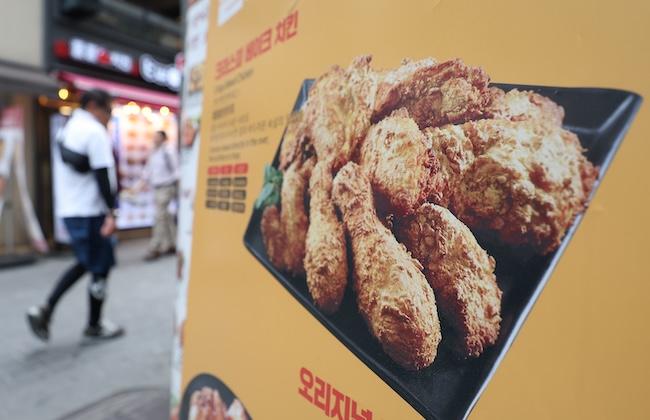
More consumers are exploring cost-effective ways to satisfy their cravings, including frying chicken at home. (Image courtesy of Yonhap)
Online, the reaction has been swift and sharp. “Chicken used to be the people’s food,” said Jung, 24, another student. “Now it costs more than most meals that actually fill you up.” Others shared photos of receipts totaling nearly 30,000 won for a single order, calling the prices “ridiculous” and “unjustifiable.”
With delivery chicken increasingly seen as a luxury, many consumers are turning to big-box supermarkets offering much cheaper, freshly cooked alternatives. Lotte Mart’s “Tongkeun Chicken,” sold at 5,000 won earlier this year, sold out during a limited promotion of 100,000 birds. Rival chains quickly followed suit: E-Mart countered with 3,500-won chicken in July, and Homeplus joined with a 4,000-won event.
Social media users now trade tips on when supermarket chicken is restocked. “I buy discounted soy-sauce chicken near closing time and reheat it in the air fryer,” one shopper wrote. “It’s crispy, tasty, and a fraction of the price.”
Consumer groups blame the unchecked price surge on opaque pricing and self-determined franchise markups.
“Raw materials account for only about 20 percent of chicken’s total price, and those costs are actually declining,” said Kim Yeon-hwa, head of the Consumer Public Interest Network. “But franchise owners freely set their own prices and pass delivery commissions and platform fees on to customers.”
Kim called for stricter government oversight to ensure greater transparency in how chicken prices are formed. “Consumers deserve to know what they’re paying for,” she said.
Lina Jang (linajang@koreabizwire.com)