
Screen showing “Golden” playing on Apple Music (Yonhap)
SEOUL, Oct. 16 (Korea Bizwire) — Apple Music is rolling out new artificial intelligence–powered features designed to enhance how listeners engage with global music — including real-time Korean-to-English lyric translation and phonetic guides for foreign-language songs.
At a media briefing in Seoul on Thursday, Apple showcased updates that arrived with its latest iOS 26 release, highlighting how the streaming service is embracing multilingual accessibility, particularly for the growing global audience of K-pop.
When users play the hit soundtrack “Golden” from Netflix’s KPop Demon Hunters, for instance, Apple Music now displays the Korean lyric “영원히 깨질 수 없는” both in phonetic English — “young won hi kkae jil su eup neun” — and in translated form, allowing non-Korean speakers to follow and sing along.
Apple said the feature was inspired by data showing that about 60 percent of its listeners read lyrics while streaming music. The translations are generated through a two-step process combining AI tools with human linguists to ensure accuracy and natural phrasing.
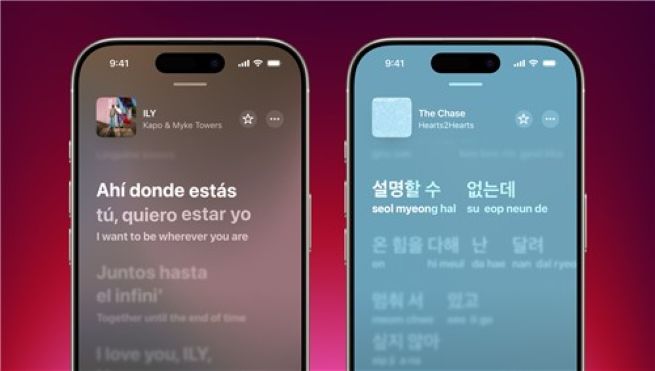
Apple Music’s lyric translation and romanization feature (Image provided by Apple)
Currently, the translation and romanization function is available for Korean-to-English lyrics, with English-to-Korean support limited to select songs. Apple plans to expand the bilingual service later this year.
Another update, AutoMix, uses AI to analyze rhythm and musical flow across more than 100 million songs, automatically blending tracks for seamless playback “like a professional DJ,” according to the company.
Apple Music has also updated its Sing feature to allow group karaoke sessions and added a “pinning” option for favorite artists and albums.
The company emphasized its continued focus on K-pop promotion, producing original radio programs hosted by Korean artists for international listeners.
“AI and machine learning are the driving forces behind our ability to deliver personal, intuitive music experiences,” said Jeff Robin, Apple’s vice president of Services Engineering. “With features like AutoMix, we’re making Apple Music feel more human — and more connected to how people actually listen.”
Kevin Lee (kevinlee@koreabizwire.com)