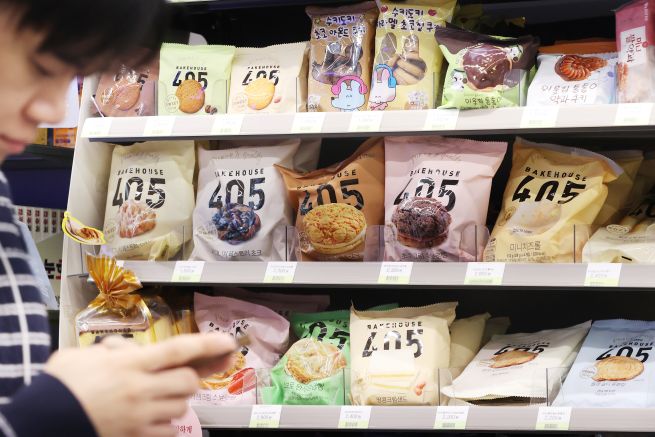
Bread displayed at a CU convenience store in Seoul on October 14, as sales of private-brand (PB) bread at convenience stores and large retailers rise amid worsening “breadflation,” or surging bread prices. (Yonhap)
SEOUL, Oct. 20 (Korea Bizwire) — South Korea’s retail industry is rapidly expanding its private brand (PB) business, pushing beyond food and household goods into clothing, new digital platforms, and even overseas markets, as companies from convenience stores to hypermarkets and e-commerce firms compete to strengthen profitability and brand identity.
According to BGF Retail, operator of the CU convenience store chain, PB sales jumped 17.6 percent in 2023 and 21.8 percent in 2024, followed by another 19.1 percent increase during the first nine months of 2025.
At GS25, which sells about 800 PB items under the “YouUs” line, PB products now account for nearly 30 percent of total sales. Its ultra-low-cost “Real Price” range saw a staggering 125 percent year-on-year surge.
Major supermarkets are following suit. Private-label goods account for roughly 8 percent of sales at Emart and 10 percent at Lotte Mart. Emart operates well-known PB labels such as No Brand, Peacock, 5K Price, and Days, while Lotte Mart promotes “Today’s Good” and “Cookit.”
Online retailers are also in on the trend. At Kurly, sales of its flagship PB lines rose more than 10 percent year-on-year, reflecting growing consumer appetite for retailer-exclusive products.
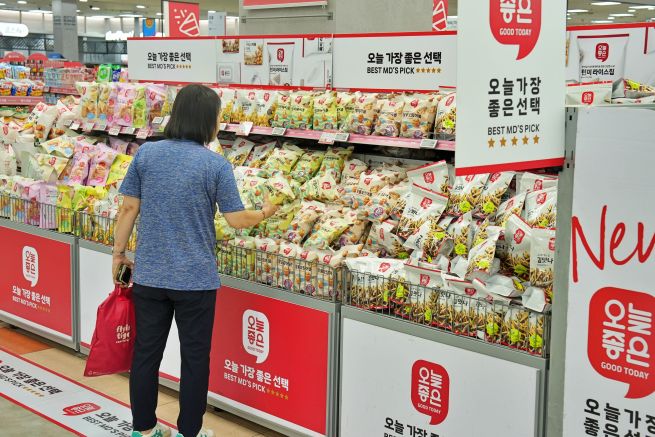
Display of Lotte Mart’s “Good Today” (PB) product section at the Zettaplex Seoul Station branch. (Image courtesy of Lotte Mart)
Cross-Platform and Cross-Border Expansion
The once-clear boundaries between retailers are dissolving as PB products appear across competing platforms. Coupang now sells Lotte Mart’s “Today’s Good” and Homeplus’s “Simplus” brands, while Emart’s Peacock products are available on Kurly’s marketplace.
Convenience chains are also going global. GS25 exports PB products to 33 countries, including the United States, Australia, Japan, and China. CU sells its own-brand items in over 20 countries, including through Japan’s Don Quijote stores.
Earlier this year, BGF Retail signed a partnership with China’s Ningxing Youbei, a major importer and distributor, to launch CU-branded sections on Chinese e-commerce platforms and operate pop-up stores promoting its products.
Meanwhile, 7-Eleven Korea entered the apparel segment in April, introducing its own socks, underwear, and T-shirts — and more recently, knitwear.
“Selling strong PB products through external channels offers both marketing and revenue advantages,” a retail industry official said. “The more customers positively experience a retailer’s PB products, the more likely they are to return to that retailer’s own platform.”
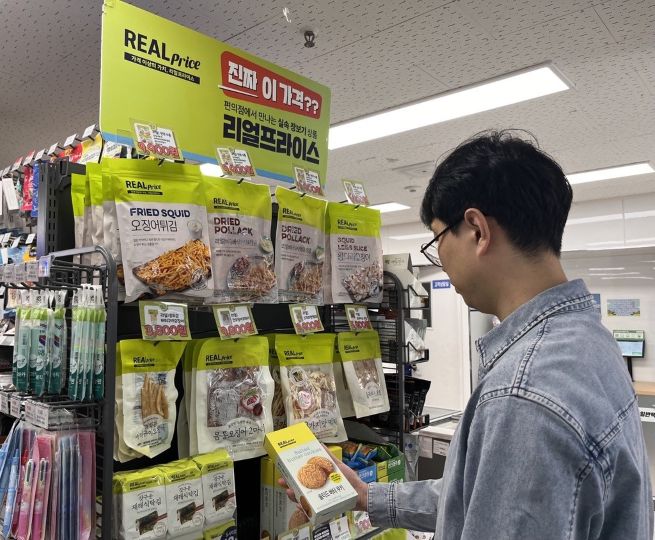
“Real Price,” the private-brand line of GS25 convenience stores operated by GS Retail, has grown rapidly, reaching cumulative sales of 50 billion won just one year after its launch in January last year. (Image courtesy of GS25)
Growing Pains and Brand Identity Risks
The PB boom, however, has raised concerns about friction with national brands (NBs). Coupang was previously indicted for allegedly manipulating search rankings to favor its own PB products.
Analysts also warn that expanding PB lines too broadly across platforms could blur brand identity and complicate logistics and inventory management — eroding the very advantages PB lines were meant to provide.
Kurly, which once sold select CU PB products, has since reverted to an in-house-only model. “We believe in maintaining brand integrity over wider exposure,” a Kurly spokesperson said, adding that the company has no plans to sell its PB products on external platforms.
Ashley Song (ashley@koreabizwire.com)