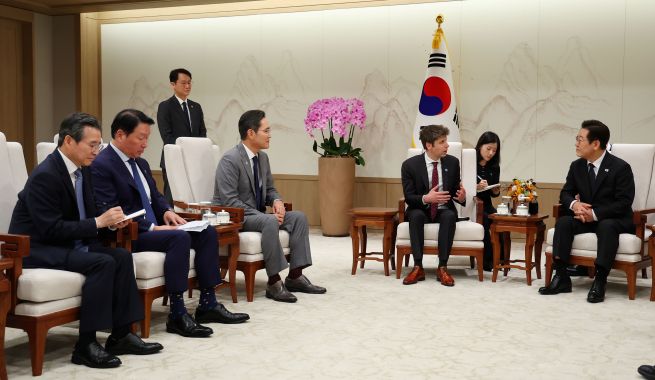
OpenAI CEO Sam Altman speaks during a meeting with President Lee Jae Myung at the presidential office in Yongsan on October 1. Samsung Electronics Chairman Lee Jae-yong and SK Group Chairman Chey Tae-won also attended the meeting. (Yonhap)
SEOUL, Oct. 23 (Korea Bizwire) — OpenAI unveiled an ambitious blueprint for its expansion into South Korea on Wednesday, calling for a dual-track strategy that combines the development of “sovereign AI” infrastructure with deeper international collaboration.
The plan marks the company’s clearest signal yet that it views South Korea as a pivotal partner in the global race for artificial intelligence leadership.
In a report titled “AI in Korea: OpenAI’s Economic Blueprint,” the company proposed a three-pronged framework centered on infrastructure, operational capacity, and data governance.
The document argues that South Korea is well positioned to overcome GPU and computing bottlenecks and to establish world-class systems for data management and AI trust.
Chris Lehane, OpenAI’s chief global affairs officer, likened the transformative potential of AI to that of electricity. “If electricity revolutionized physical productivity, AI will revolutionize cognitive productivity,” he said at a media roundtable in Seoul.
“Korea has four historical strengths — semiconductors, digital infrastructure, talent, and government support — that position it for leadership in the AI era.”
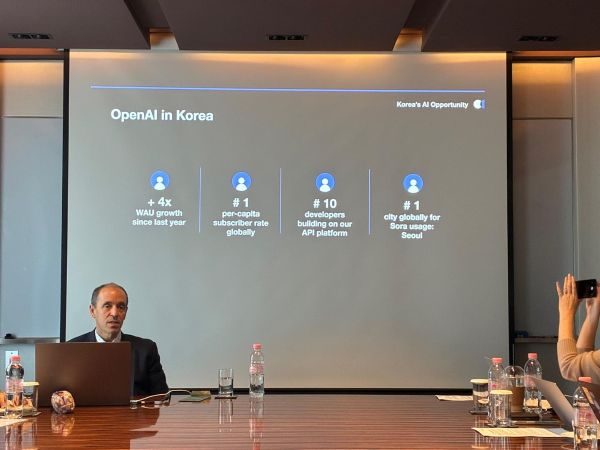
Chris Lehane, OpenAI’s chief global affairs officer (Yonhap)
Lehane noted the rapid growth of OpenAI’s user base in South Korea, which now counts about 17 million weekly active users — quadruple last year’s figure — the highest per capita subscription rate in the world. Seoul, he added, ranks as the global leader in usage of Sora, OpenAI’s video-generation model.
The report urged Korea to pursue a “dual-track” approach — building national AI capabilities, such as domestic infrastructure and chip supply, while maintaining partnerships with leading global developers.
OpenAI cited its recent agreements with Samsung Electronics, SK hynix, and the Ministry of Science and ICT under the “Stargate Initiative” as examples of this cooperative model.
The agreements include DRAM wafer supply deals and plans to support the development of domestic AI data centers. While Lehane said OpenAI is not directly involved in the government’s national AI computing center project, he left the door open to future collaboration. “If invited, we’re ready,” he said, suggesting that a joint public-private framework — dubbed “Stargate Korea” — could emerge.
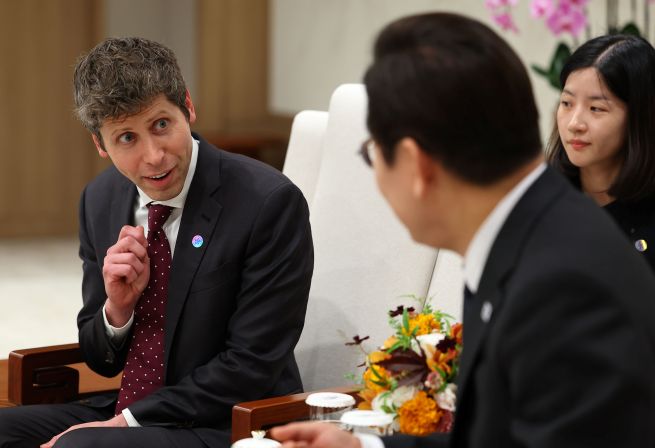
OpenAI CEO Sam Altman speaks during a meeting with President Lee Jae Myung at the presidential office in Yongsan on October 1. (Yonhap)
Lehane also emphasized expanding access to high-performance computing for startups, universities, and public institutions, describing it as a potential model of “public computing” once local data centers are operational.
The report identified industries such as manufacturing, small and medium enterprises, healthcare, and education as the first sectors where AI could deliver near-term economic benefits. It proposed that the government integrate technological, financial, and policy support into a national “K-AI ecosystem” — an end-to-end framework for domestic innovation.
If Korea sustains its current pace, Lehane said, 2025 could become “the first year of agentic AI,” with advances expanding into healthcare and science by 2026 and robotics by 2027.
Addressing rising cybersecurity concerns following a string of hacking incidents in Korea, Lehane noted that OpenAI’s new browser-based platform Atlas allows users to control how their data and memory are stored. “In a market as highly regulated as Korea, user control could be the ultimate competitive edge,” he said.
OpenAI launched Atlas earlier this week in the United States, signaling a direct challenge to Google’s dominance in web search — and underscoring its broader strategy to make AI not just an innovation tool, but an everyday infrastructure.
Kevin Lee (kevinlee@koreabizwire.com)