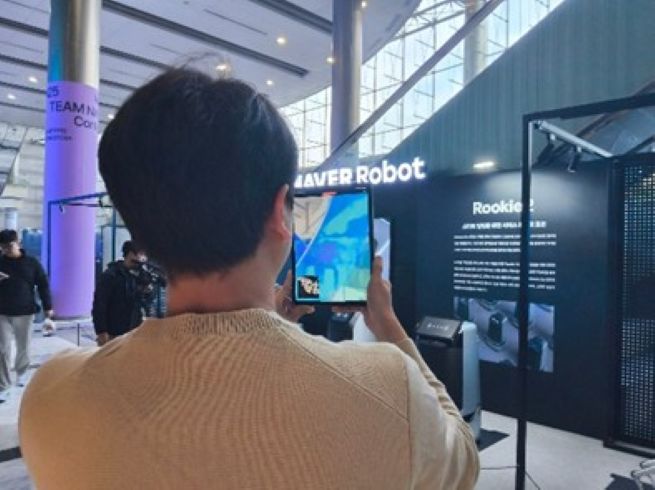
Naver’s “DAN25” VR tour implementation (Photo courtesy of Naver)
SEOUL, Nov. 10 (Korea Bizwire) — Naver’s latest virtual reality (VR) technology has reached a stage where it can be implemented using only a 360-degree camera and a smartphone, marking a major step toward mass adoption, the company said Sunday.
According to Naver, its research arm Naver Labs tested the new system this week by creating a VR tour of the “DAN25” conference at Seoul’s COEX convention center.
Engineers filmed the venue with a 360-degree camera at 8 a.m. and, after AI-based processing, launched a VR tour on Naver Maps by 2 p.m. the same day.
The company emphasized the accessibility of the process, noting that it requires no complex mapping equipment. The experiment demonstrated the efficiency of Naver’s “3D VR Solution,” which integrates real-time mapping, AI spatial analysis, and cloud processing into a single streamlined workflow.
Naver expects the technology to accelerate the everyday use of VR in real estate, retail, and construction. The company’s existing Naver Real Estate VR Tour service already allows users to explore apartments and homes remotely through immersive 360-degree views.
As of November, more than 70,000 listings include VR tours, which have resulted in longer user engagement and higher transaction rates than standard listings.
The same technology also powers Naver Place’s “Store View 3D,” which lets users preview restaurants, cafés, and pop-up shops virtually before visiting.
Beyond accessibility, Naver Labs is developing tools that allow users to update 3D spatial data using only smartphone cameras. Its “ARC Eye” scanning app merges mapping and positioning technologies, enabling users to scan and automatically update existing digital twins of physical spaces.
A Naver Labs official said the team is now focused on the next phase of “spatial intelligence” research, preparing for a future where devices like AR glasses and service robots will rely on embedded space-recognition technologies.
“In a world moving beyond smartphones,” the official said, “Naver Labs aims to become a key provider of the spatial intelligence that will power the next generation of devices.”
Kevin Lee (kevinlee@koreabizwire.com)