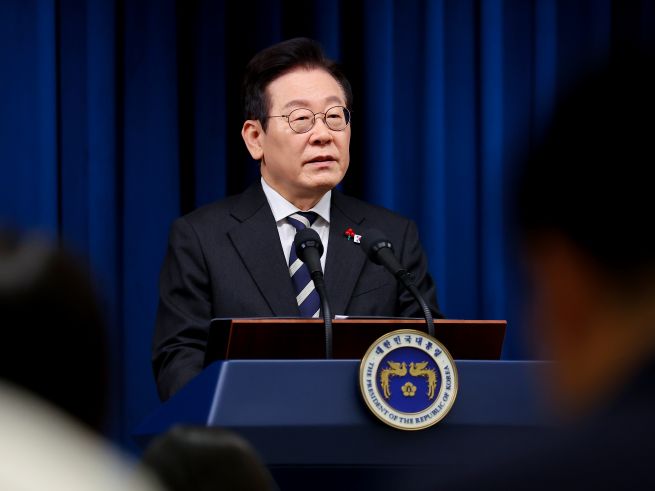
President Lee Jae-myung delivers a special national address marking the first anniversary of the Dec. 3 martial law crisis — the ‘Revolution of Light’ — at the presidential office in Yongsan on Dec. 3 (Yonhap)
President Lee Jae-myung on Dec. 3, marking the first anniversary of the martial-law crisis, declared, “We will complete the Revolution of Light and build a true nation of popular sovereignty.”
In a special national address titled “First Anniversary of the Revolution of Light” delivered at the presidential office in Yongsan that morning, Lee said, “I will always remember the significance of the birth of a government rooted in the sovereign will of the people.”
He continued, “To honor the people’s extraordinary courage and action, we will designate December 3 as ‘People’s Sovereignty Day.’ The people of Korea, who overcame a crisis of democracy through peaceful means, fully deserve the Nobel Peace Prize.”
Lee stressed that “righteous unity” is essential to making South Korea “a nation where no one can ever again dream of staging a coup, and where no one can threaten the light of the people’s sovereignty,” adding, “Strict punishment of those who took part in the loyalist coup is the starting point.”
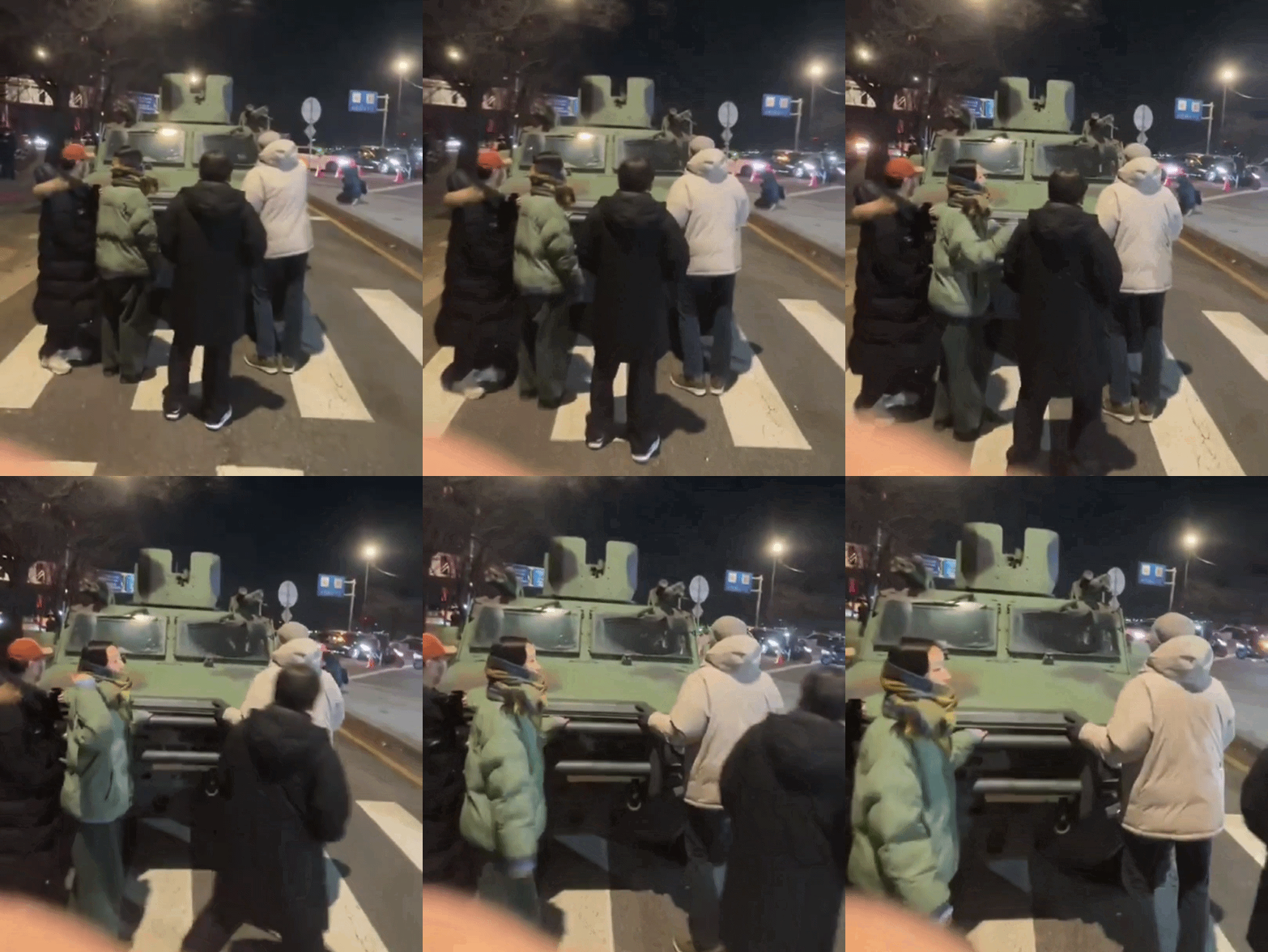
A citizen, identified as Mr. A, captured this scene on video as he blocked a military vehicle with his bare body on a road near the National Assembly in Seoul at dawn on December 4 last year, when the emergency martial law was declared. The image is a screenshot from Mr. A’s X account. At the time, Lee Jae-myung, then leader of the Democratic Party, was deeply moved by the citizen’s courage and publicly asked, “Please find out who this person is,” a remark that drew wide public attention.
Below is the full text of the special address:
“Fellow citizens,
Today marks one year since the beginning of the Revolution of Light.
It was the first time in the 21st century that a loyalist coup occurred in a democracy comparable to South Korea, and it was also the first time in world history that an unarmed citizenry stopped such a coup peacefully and with dignity.
Paradoxically, the coup attempt on December 3 revealed to the world the Korean people’s profound commitment to sovereignty and the remarkable resilience of Korean democracy.
When the coup broke out, our people ran to the National Assembly without a moment’s hesitation.
You blocked armored vehicles headed toward the Assembly with your bare bodies, confronted the police who tried to seal off the legislature, and helped lawmakers climb over the Assembly walls so they could fulfill their constitutional duties.
The Assembly’s vote to lift martial law and the military’s faithful compliance under civilian control were possible only because you, the people, stood up.
I also remember the young people who stood guard through the night in front of the Assembly’s gates to prevent a second declaration of martial law.
And I vividly remember the citizens who sat on the cold asphalt in the middle of a winter snowstorm, relying only on a thin emergency blanket.
I remember the warmhearted people who sent prepaid support saying they felt sorry they couldn’t join the demonstrations.
I remember the spirit of solidarity when countless people rushed to Namtaeryeong to protect the farmers, even when all public transportation had stopped.
They were profoundly unjust—but our people were profoundly just.
Through dance and song, not violence, the people transformed the nation’s darkest moment—triggered by an illegal loyalist coup—into its finest hour.
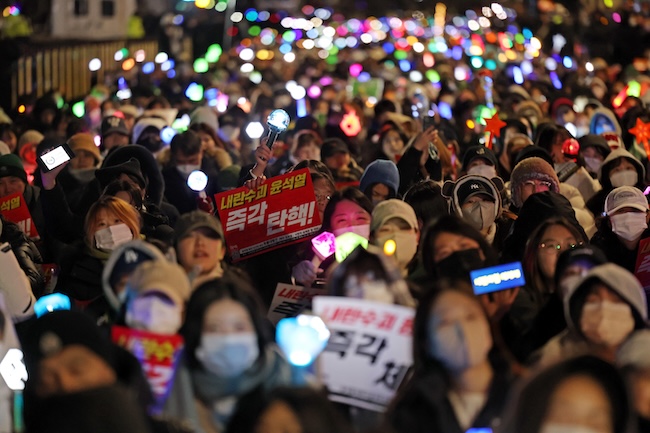
Protesters holding banners and light sticks call for President Yoon Suk Yeol’s impeachment and arrest in front of the National Assembly on Dec. 8, 2024. (Image courtesy of Yonhap)
With a radiant burst of color, the Korean people restored light to a country that had nearly fallen back into darkness.
I offer my deepest gratitude to the great people of Korea for showing such courage and the shining power of solidarity.
The government born of the Revolution of Light will designate December 3 as People’s Sovereignty Day, in honor of your extraordinary bravery and action.
As long as our Republic exists, we will celebrate the defense of constitutional order and democracy, and reaffirm our commitment to making them even stronger.
The December 3 coup was not merely a crisis for one nation’s democracy.
As many foreign media noted, if Korea’s democracy had collapsed, democratic backsliding would have swept across Asia and beyond.
Democracy is one of the greatest systems humanity has created, but it is not perfect in itself.
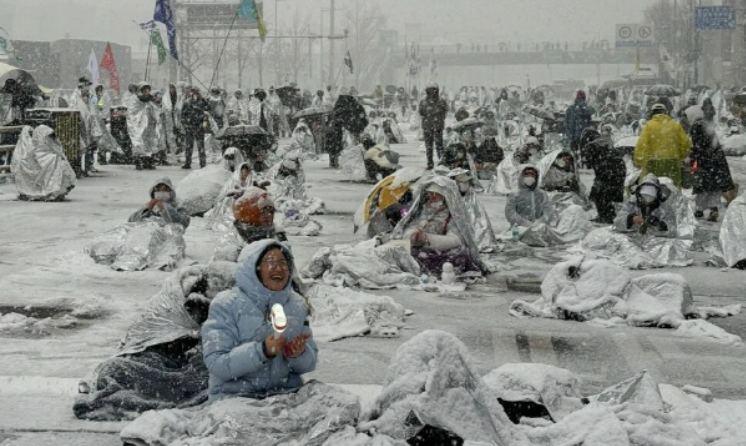
On the morning of January 5, as a heavy snow advisory blanketed all of Seoul, citizens wrapped in silver emergency blankets held a sit-in protest at the “Workers and Citizens Yoon Suk-yeol Arrest Rally” near the presidential residence in Yongsan District. (Photo provided by the office of Progressive Party lawmaker Jeong Hye-kyung.)
No matter how sophisticated the laws or institutions, without citizens who uphold and practice them, they are nothing but a house of cards.
In this sense, the Korean people’s peaceful defeat of illegal martial law—through constitutional and lawful means—stands as a historic event in global democracy.
It showed how powerful democracy can be when democratic institutions and peaceful methods are animated by a sovereign people.
I firmly believe that the Korean people, who overcame an unprecedented democratic crisis through peaceful means, fully deserve the Nobel Peace Prize.
If the Korean people are awarded the Nobel Peace Prize for preserving democracy, restoring peace, and showing the world the greatness of democratic action, it would become a turning point for all nations shaken by conflict and division.
My fellow citizens, the Revolution of Light is not yet complete.
The investigation into the insurrection and the trials of those who participated in it are still under way.
Just as the past can save the present, and the dead can aid the living, the Revolution of Light must guide the future and safeguard our descendants. That is the solemn responsibility of a government grounded in the sovereignty of the people.
Strict punishment for those who took part in the loyalist coup is the beginning.
Those who destroyed constitutional order for personal ambition—and even plotted war—must be held accountable.
‘Righteous unity’ is essential in building a nation where no one can ever again dream of staging a coup, and where no one can threaten the light of the people’s sovereignty.
Together with you—the great people who lit the torch of democracy—we will complete the Revolution of Light.
Fellow citizens, since taking office I have met world leaders who expressed deep interest and high expectations for South Korea.
In this time of uncertainty, when democracy is under threat and the global order is shifting, the world is watching the courage and resolve the Korean people have shown.
Korea is now writing a chapter of world history.
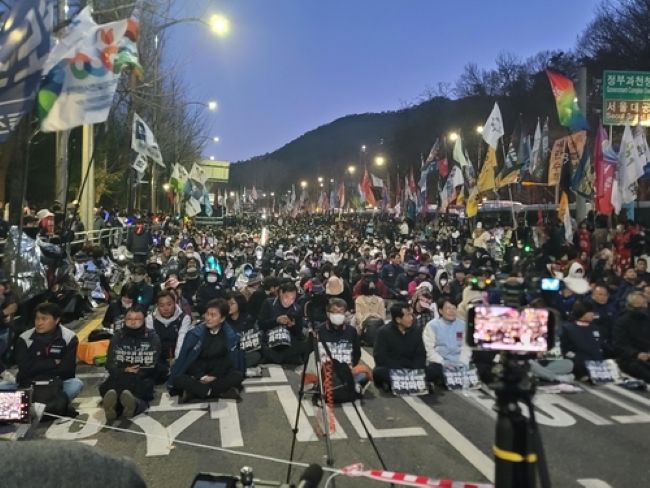
Tractors and trucks are at a standstill following police orders during a farmers’ group protest calling for President Yoon Suk Yeol’s impeachment in southern Seoul on March 25, 2025. (Image courtesy of Yonhap)
The model you set during the Revolution of Light is establishing a new global standard for democracy.
The road ahead, like the one behind us, will be one that no one has walked before.
Sometimes a deep valley, sometimes a high mountain may block our way.
But the Korean people—who scaled even the high wall of a loyalist coup—can overcome any obstacle.
We will always remember the meaning of a government born through the sovereignty of the people.
With faith in the people, we will boldly advance to complete the Revolution of Light and build a true nation of popular sovereignty.
We will create a country that is more prosperous, stronger, and more humane.
I believe the people of Korea will walk beside us as steadfast partners in this hopeful journey, as we write a new chapter in the proud history of our Republic.
Thank you.”
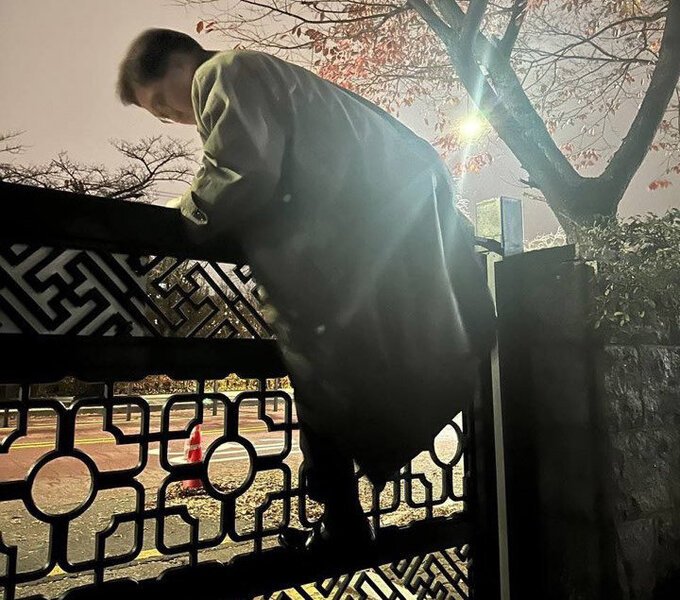
National Assembly Speaker Woo Won-shik climbs over the wall of the National Assembly in Yeouido, Seoul, on the night of December 3, following the declaration of martial law. (Image provided by the Office of the Speaker.)