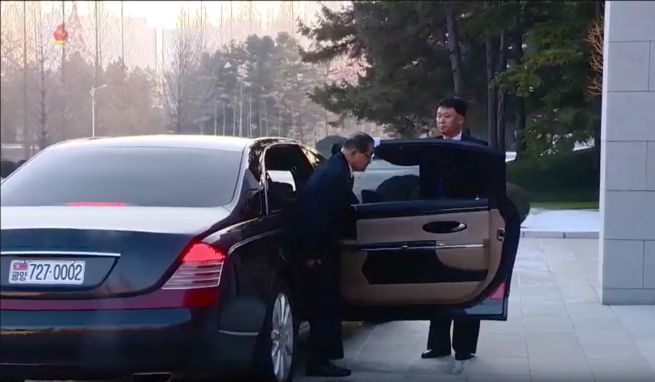
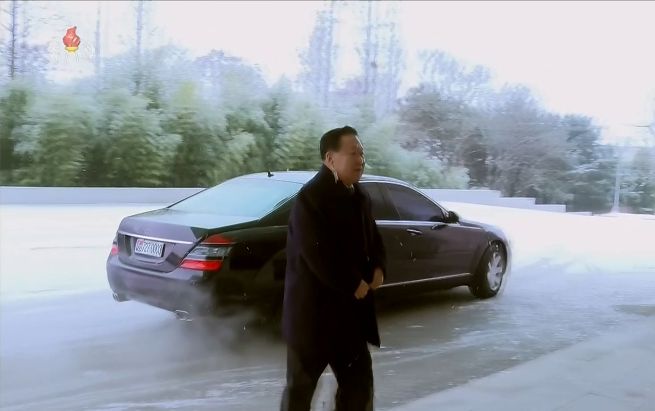
Pak Thae-song, North Korea’s premier, is seen stepping out of a sedan bearing the license plate “7.27.0002” as he arrives to attend the expanded meeting of the 13th plenary session of the 8th Central Committee of the Workers’ Party of Korea on the 11th. (Image source: Korean Central Television, For Use Only in the Republic of Korea. No Redistribution)
SEOUL, Dec. 30 (Korea Bizwire) — North Korea appears to be signaling a subtle but meaningful shift in its internal power structure, with new clues emerging from the license plates used by the country’s top leadership.
An analysis of state media footage by Yonhap News Agency shows that Kim Jong Un has recently been using a vehicle bearing the license plate “7·27 0001,” a designation long associated with the country’s supreme leader. Attention has since turned to the numbering that follows — and what it may reveal about the hierarchy beneath him.
According to footage aired by Korean Central Television and other state outlets, Prime Minister Pak Thae-song uses a vehicle marked “0002,” while Choe Ryong-hae, chairman of the Standing Committee of the Supreme People’s Assembly, uses “0003.”
Analysts say the sequencing suggests that the prime minister now ranks above the legislature’s top official in formal protocol — a notable departure from past norms.
The finding reinforces a broader trend under Kim’s rule, in which the Cabinet has gained prominence relative to the ruling Workers’ Party and the military, institutions that dominated power during the eras of Kim Il Sung and Kim Jong Il.
Pak’s elevated status is also reflected in recent state events, where he has been named first among members of the Politburo Standing Committee, underscoring his position as the regime’s de facto second-in-command.
Choe Ryong-hae, chairman of the Standing Committee of North Korea’s Supreme People’s Assembly, is seen getting out of a sedan bearing the license plate “7.27.0003” and heading to the venue to attend a ceremony marking Constitution Day on the 27th. (Image source: Korean Central Television, For Use Only in the Republic of Korea. No Redistribution)
Experts interpret the shift as part of Kim Jong Un’s effort to strengthen the Cabinet’s role in managing the economy, particularly as North Korea pushes initiatives such as its “20×10 regional development” policy aimed at easing chronic livelihood challenges.
By elevating the prime minister’s stature, Kim may be seeking to place greater responsibility for economic performance on the Cabinet, while insulating the supreme leadership from direct blame.
Lim Eul-chul, a professor at Kyungnam University’s Institute for Far Eastern Studies, said the move carries symbolic weight. “Aside from military affairs, Pak Thae-song is effectively the chief operational manager of the system,” he said, adding that enhancing his protocol standing sends a clear message to both elites and the public that economic development and everyday living conditions have become top priorities.
While the Workers’ Party remains the ultimate center of power in North Korea, the numbering on a handful of license plates now offers a rare, tangible glimpse into how authority under Kim Jong Un may be quietly recalibrating.
M. H. Lee (mhlee@koreabizwire.com)