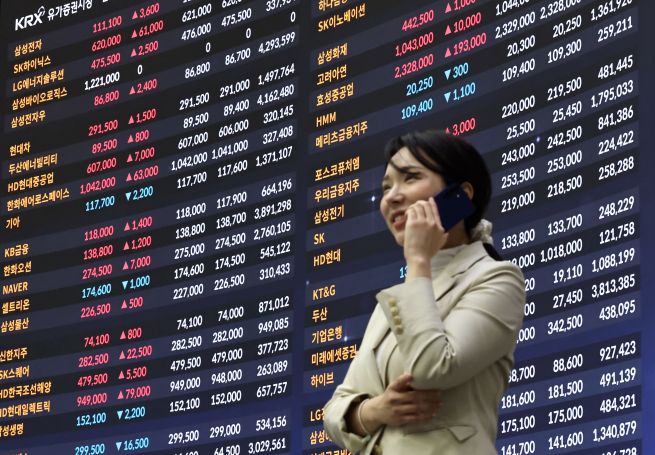
An electronic display board at the Korea Exchange promotion hall in Yeongdeungpo, Seoul. (Yonhap)
SEOUL, Jan. 9 (Korea Bizwire) — South Korea’s campaign to boost corporate value is reshaping the stock market, with companies sharply increasing share buybacks, cancellations and dividends, helping narrow the long-standing valuation gap known as the “Korea discount,” the country’s main exchange said on Thursday.
The Korea Exchange said that in 2025—the second year of its corporate value-up program—listed companies bought back a record 20.1 trillion won ($15.3 billion) worth of their own shares and canceled 21.4 trillion won, both the highest levels on record.
The figures more than doubled those seen before the program’s launch in 2023 and rose sharply from 2024.
Cash dividends have also climbed steadily, reaching 50.9 trillion won in 2025, up from 43.1 trillion won in 2023, as more companies adopt shareholder-friendly policies, the exchange said.
By the end of last year, 174 listed companies had disclosed formal value-up plans, including 130 firms on the main KOSPI market and 41 on the tech-heavy Kosdaq.
Nearly 60 companies have gone further, filing periodic updates to report progress and maintain regular communication with investors. About half of the companies that made disclosures also released English-language filings aimed at foreign investors.
The impact has been visible in market performance. The Korea Value-Up Index, which tracks companies with strong shareholder-return policies, surged 89.4 percent in 2025 to a record high, outpacing the broader KOSPI by nearly 14 percentage points.
Exchange-traded funds linked to the value-up strategy saw assets swell to 1.3 trillion won, while foreign participation in trading nearly doubled.
Korea Exchange Says Value-Up Program Is Reshaping Market Behavior (Image courtesy of Korea Exchange)
Valuation metrics have also improved. At the end of 2025, the price-to-book ratio and price-to-earnings ratio of the MSCI Korea Index stood at 1.59 and 17.47, respectively—well above levels seen in recent years, when Korean equities were widely viewed as undervalued relative to global peers.
The Korea Exchange said it would continue to push the value-up initiative in 2026, aligning it with the Democratic Party–led government’s broader capital-market reforms.
Plans include updated disclosure guidelines, the selection of top-performing value-up companies in May, and a shift toward index construction that gives greater weight to firms demonstrating sustained improvements in shareholder value.
Officials said the goal is to entrench a culture of corporate governance and investor returns that can sustain the recent rally and further close the valuation gap that has long weighed on South Korea’s equity market.
Ashley Song (ashley@koreabizwire.com)