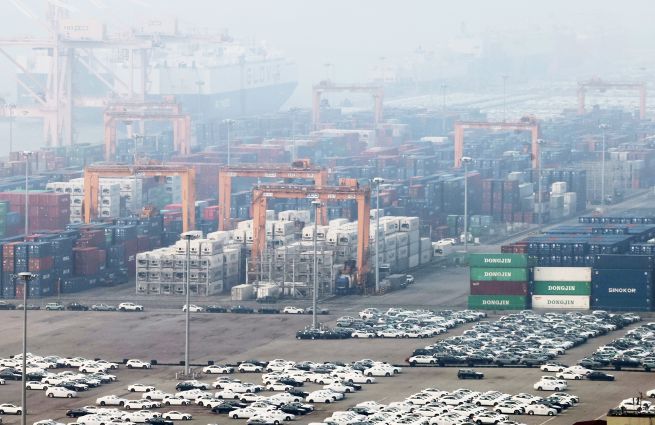
South Korea’s exports surpassed $700 billion for the first time in 2025, a historic milestone achieved 77 years after the founding of the government in 1948. With exports reaching $700 billion, the country became the world’s sixth-largest exporter, following the United States, Germany, China, Japan and the Netherlands. According to the Ministry of Trade, Industry and Energy and the Korea Customs Service on Dec. 29, cumulative exports for the year were provisionally tallied at $700 billion as of 1:03 p.m. that day. The photo shows stacks of containers at Pyeongtaek Port in Gyeonggi Province. (Yonhap)
SEOUL, Jan. 9 (Korea Bizwire) – South Korea posted its largest-ever current account surplus for any November, supported by strong exports amid an upcycle in the semiconductor industry, central bank data showed Friday.
The country’s current account surplus totaled US$12.24 billion in November, up sharply from $6.81 billion a month earlier, according to the data from the Bank of Korea (BOK).
It marked the highest level for any November since the BOK began compiling relevant data in 1980.
South Korea has recorded a current account surplus every month since May 2023, marking the second-longest surplus streak on record.
During the first 11 months of last year, the cumulative surplus totaled $101.82 billion, compared with $86.68 billion during the same period in 2024, marking the largest amount ever recorded for the cited period, the BOK said.
Containers are stacked at a port in the South Korean city of Pyeongtaek on Jan. 1, 2026. (Yonhap)
The goods account posted a surplus of $13.31 billion in November, up from $7.82 billion a month earlier, as exports rose 5.5 percent on-year to $60.11 billion.
Chip exports jumped 38.7 percent from a year earlier, while vehicle shipments increased 10.9 percent.
Imports edged down 0.7 percent on-year to $46.8 billion in November.
The services account recorded a deficit of $2.73 billion in November due mainly to a surge in overseas travel demand, though the figure narrowed from a $3.75 billion deficit logged a month earlier.
The primary income account, which includes wages of foreign workers, as well as dividend and interest income from abroad, posted a surplus of $1.83 billion, driven primarily by dividend earnings.
The secondary income account recorded a deficit of $180 million, the data showed.
In the financial account, net assets increased by $8.27 billion in November, widening from the previous month’s $6.81 billion.
In detail, overseas direct investment by South Korean residents rose by $4.09 billion, while foreign direct investment in South Korea increased by $1.76 billion, resulting in a $2.33 billion net increase in the financial account.
(Yonhap)