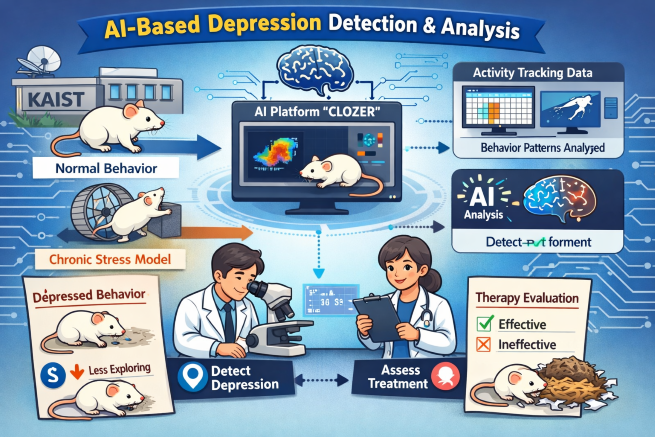
From Subtle Movements to Mental Health: AI Tool Offers New Way to Identify Depression (Image supported by ChatGPT)
DAEJEON, Jan. 14 (Korea Bizwire) — South Korean researchers have developed an artificial intelligence–based system that can objectively detect depression and assess treatment effects by analyzing everyday behavior, a breakthrough that could pave the way for more precise mental health diagnosis and care.
According to Korea Advanced Institute of Science and Technology, a research team led by Professor Heo Won-do in the Department of Biological Sciences has created an AI platform called “CLOZER” that examines daily behavioral patterns at an exceptionally fine scale. By breaking behavior into minute components, the system can identify subtle changes that are difficult to detect with the human eye.
Using a widely accepted mouse model of depression based on chronic unpredictable stress, the researchers demonstrated that CLOZER could reliably distinguish depressive states solely through behavioral data.
The platform was able to differentiate symptoms by both sex and severity, revealing that stress alters not physical ability itself but the frequency and flow of everyday actions.
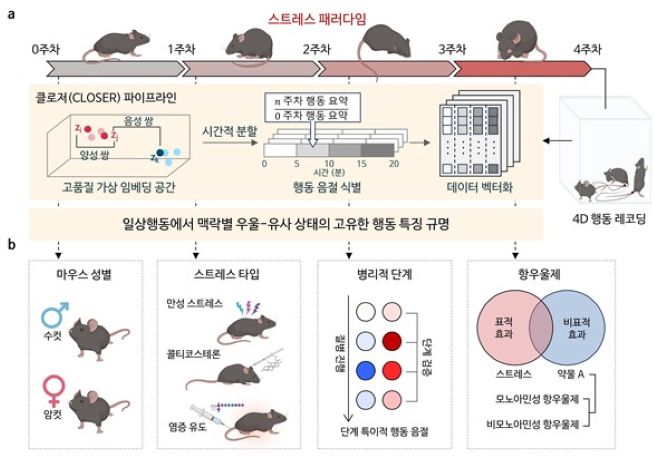
Schematic illustration of the research (Image provided by the Korea Advanced Institute of Science and Technology (KAIST))
Notably, male and female mice showed contrasting behavioral responses to prolonged stress, underscoring the importance of sex-specific analysis in depression research.
The study also found that persistent stress or inflammation led to clear behavioral changes, while exposure to stress hormones alone produced little effect—suggesting that daily behavior analysis may help distinguish underlying causes of depression.
Professor Heo said the work represents the world’s first preclinical framework to apply AI-driven daily behavior analysis to personalized diagnosis and treatment evaluation for depressive disorders, laying a foundation for tailored therapies and precision psychiatry.
The findings were published online on December 30 in the international journal Nature Communications.
Kevin Lee (kevinlee@koreabizwire.com)