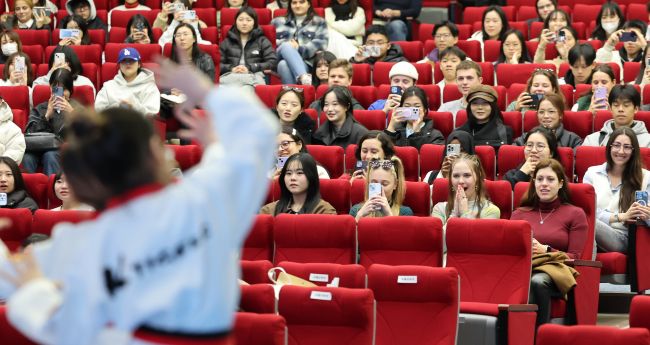
On May 28, international students attending the 2025 spring semester orientation at the university theater of the Daeyeon Campus of Pukyong National University in Nam-gu, Busan, enjoy a Taekwondo demonstration. (Image courtesy of Yonhap)
SEOUL, Jan. 16 (Korea Bizwire) — More than one in 10 foreign students who entered South Korea to attend universities or language institutes have ended up overstaying their visas illegally, underscoring growing concerns that the country’s foreign student recruitment policy has prioritized scale over sustainability.
According to a study published this week in the Journal of the Korean Association for Immigration Studies by Kim Gyu-chan, an associate professor at Gangneung-Wonju National University, the number of undocumented residents who originally entered South Korea on student visas reached 34,267 in 2024—more than five times the figure recorded a decade earlier.
The data, obtained through a Freedom of Information request to the Justice Ministry, show that 9,580 overstayers had entered on academic student visas (D-2), while 24,687 came on language-training visas (D-4).
The share of foreign students who later became undocumented rose from 7.8 percent in 2014 to a peak of 15.7 percent in 2022, before easing to 11.6 percent in 2024—still well above mid-2010s levels.
Professor Kim said the trend suggests that while South Korea has succeeded in expanding the number of international students, the quality and stability of their stay have deteriorated.
Vietnamese nationals accounted for the overwhelming majority of overstayers, particularly among language trainees, raising concerns that rapid expansion of language programs may be aggravating risks tied to students from specific countries.
The findings come despite the government’s stated goal of attracting global talent. Under the Education Ministry’s “Study Korea 3.0” initiative, Seoul aims to host 300,000 international students, while immigration authorities have sought to encourage longer-term settlement by treating students as potential future workers.
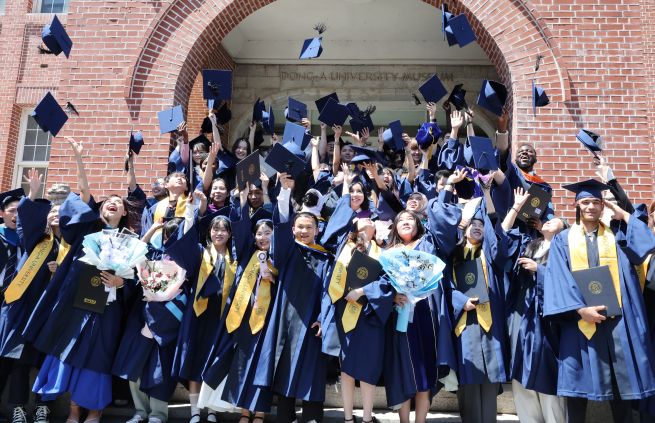
On August 21, international students pose for a commemorative photo in front of the Seokdang Museum after the 2024 fall semester graduation farewell ceremony for foreign students at Dong-A University’s Bumin Campus in Seo District, Busan. This semester, a total of 74 international students from nine countries graduated, including 22 undergraduates, 45 from the general graduate school, and 7 from the international graduate school. (Yonhap)
In practice, however, the study found a widening gap between policy ambitions and outcomes. Kim urged policymakers to move beyond viewing foreign students as a stopgap solution to shrinking domestic enrollment and instead recognize them as long-term human capital.
He called for a redesign of student policy along the lines of Germany and Japan, including better job access, a unified data platform linking immigration, education and universities, and stronger career support for graduates.
“Without structural changes, expanding student numbers alone will not translate into successful settlement or talent retention,” Kim said, warning that unmanaged growth could further deepen irregular residency problems rather than solve them.
Lina Jang (linajang@koreabizwire.com)