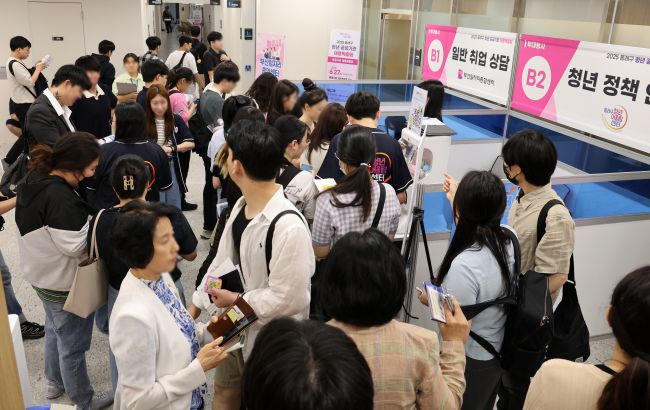
A job fair in Busan, some 325 kilometers southeast of Seoul, is filled with job seekers in this June 27, 2025, file photo. (Image courtesy of Yonhap)
SEOUL, Jan. 19 (Korea Bizwire) – Longer job searches and soaring housing costs are placing mounting strain on young South Koreans, deepening concerns that structural weaknesses in the economy could weigh on the country’s long-term growth, the central bank said on Monday.
In a report examining the economic conditions of young adults, the Bank of Korea found that many job seekers are spending extended periods unemployed at the start of their careers, as companies increasingly favor experienced workers and rely on rolling recruitment instead of large, once-a-year hiring rounds. The shift has unfolded against the backdrop of sluggish economic growth, narrowing entry-level opportunities.
The consequences, the report warned, can linger for years. Young people who remain unemployed for one year have a 66.1 percent chance of securing a regular job within five years. That likelihood falls to 56.2 percent when unemployment stretches to three years. Each additional year without work reduces current real wages by an estimated 6.7 percent, reflecting what economists describe as a lasting “scarring effect.”
The pattern, the central bank noted, bears resemblance to Japan’s so-called lost generation — workers who entered the labor market during the country’s prolonged stagnation in the 1990s and early 2000s and struggled to recover stable career trajectories.
Housing pressures are compounding those difficulties.
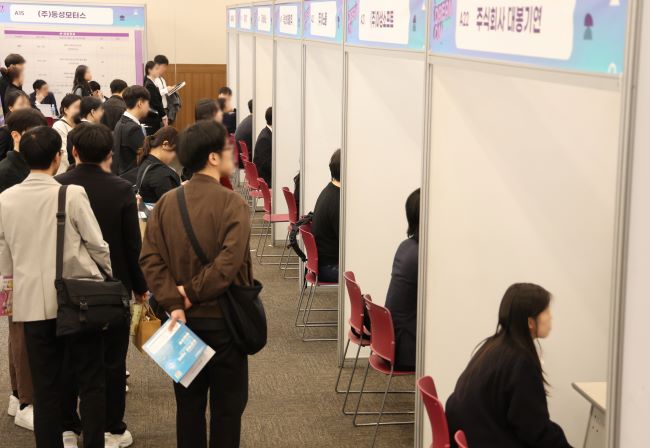
Young job seekers attending on-site interviews.
(Image courtesy of Yonhap)
Young adults, who typically rely on rental housing while studying or working, are facing sharply higher monthly rents amid a shortage of small, non-apartment units. As affordability deteriorates, living conditions have worsened. The share of young people residing in substandard housing more than doubled to 11.5 percent in 2023, from 5.6 percent in 2010, the report showed.
Rising housing costs are also eroding financial stability. A 1 percent increase in housing expenses was estimated to reduce total household assets among young people by 0.04 percent, while their share of overall household debt climbed to 49.6 percent in 2024, up from 23.5 percent in 2012.
Together, the trends point to challenges that extend beyond individual hardship.
“The employment and housing difficulties facing young people are structural problems that ultimately constrain Korea’s growth potential,” Lee Jae-ho, a Bank of Korea official, said in a briefing. He added that reforms are needed to ease labor market polarization and that expanding the supply of smaller housing units would be essential to correcting imbalances in the rental market.
As South Korea confronts slowing growth and a rapidly aging population, the report suggests that the struggles of its younger generation may increasingly shape the country’s economic future — not only as a social concern, but as a test of long-term resilience.
Lina Jang (linajang@koreabizwire.com)