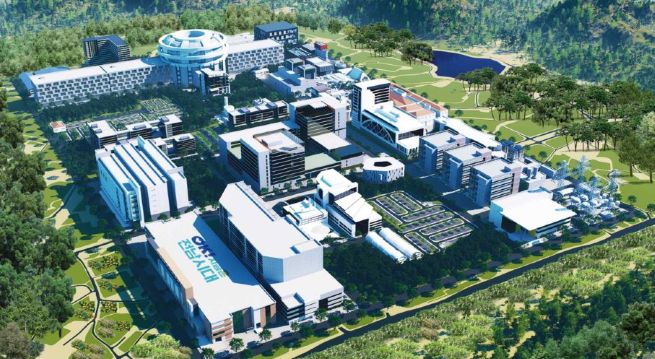
An artist’s rendering of an artificial sun research facility. (Image courtesy of Naju City)
SEOUL, Jan. 22 (Korea Bizwire) — South Korea said Wednesday it will sharply increase investment in nuclear fusion research this year, nearly doubling its budget as the government accelerates efforts to move the technology from laboratory development toward real-world demonstration and eventual commercialization.
The Ministry of Science and ICT announced that it has finalized its 2026 implementation plan for fusion research and development, allocating 112.4 billion won, a 99 percent increase from last year.
A portion of the funding will be directed toward developing design technologies for a Korean-style innovative fusion reactor, with the government investing 2.1 billion won to refine a long-term roadmap for demonstration and commercial use.
The plan also places heavy emphasis on artificial intelligence. About 4.5 billion won will be invested in new projects that apply A.I. to fusion research, including plasma control, analysis of experimental and operational data, and advanced reactor design and simulation.
While South Korea has long focused on the tokamak approach — used in its flagship KSTAR experimental reactor — the government said it will expand support for alternative fusion concepts, aiming to diversify next-generation technologies and strengthen the research talent pipeline.
To reinforce collaboration, the ministry plans to formalize partnerships among national research institutes, universities and private companies through a “fusion innovation alliance.” By the first half of the year, eight core fusion technology areas will be organized under a unified industry-academia-research framework.
The government also plans to strengthen regional research infrastructure, including the completion of a superconducting conductor testing facility, and to launch a preliminary feasibility study for a large-scale, 1.5 trillion won program focused on developing key fusion technologies.
Additional strategies include an “AI-plus-fusion” roadmap, expanded international cooperation, and plans for an upgraded KSTAR 2.0 research device. Officials said revisions to the Fusion Energy Promotion Act will also be pursued to strengthen industrial support mechanisms.
“Our goal is to expand both the speed and scope of fusion research,” Kim Sung-soo, director general for research policy at the ministry, said in a statement. “By systematically linking technology development with demonstration and industrialization, we aim to accelerate the realization of fusion-based power generation.”
The investment underscores South Korea’s growing ambition to position itself among global leaders in fusion energy, as governments worldwide intensify efforts to secure carbon-free power sources for the long term.
Kevin Lee (kevinlee@koreabizwire.com)