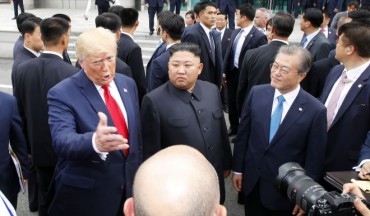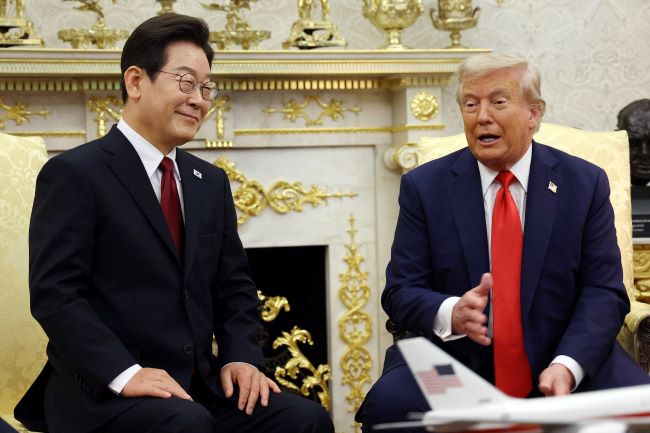
South Korean President Lee Jae Myung (L) holds talks with U.S. President Donald Trump in the Oval Office of the White House in Washington on Aug. 25, 2025. (Image courtesy of Yonhap)
WASHINGTON, Jan. 24 (Korea Bizwire) – A newly released U.S. defense strategy is signaling a subtle but consequential shift in Washington’s approach to the Korean Peninsula, raising the prospect of changes to the American military footprint in South Korea and placing new expectations on Seoul to assume greater responsibility for its own defense as the United States refocuses on countering China.
The Pentagon’s 2026 National Defense Strategy, published Friday, states that South Korea is now capable of taking “primary” responsibility for deterring North Korea, with the United States providing what it described as “critical, but more limited” support. The language reflects Washington’s broader effort to update its force posture overseas as it seeks to concentrate military resources on strategic competition with Beijing.
Analysts said the document underscores a recalibration of roles within the alliance, one that aligns closely with President Donald Trump’s America First doctrine, which calls on allies to shoulder more of the burden for their own security. It also comes as President Lee Jae Myung’s administration pursues a parallel goal: strengthening South Korea’s independent defense capabilities and regaining wartime operational control of its military from the United States.
“This signals a shift in U.S. strategic focus that requires a redistribution of responsibilities within the alliance,” said Ellen Kim, director of academic affairs at the Korea Economic Institute of Korea. “South Korea is expected to take the lead in responding to North Korea’s conventional threats, while the United States concentrates on providing strategic assets and deterrence against nuclear and other weapons of mass destruction.”
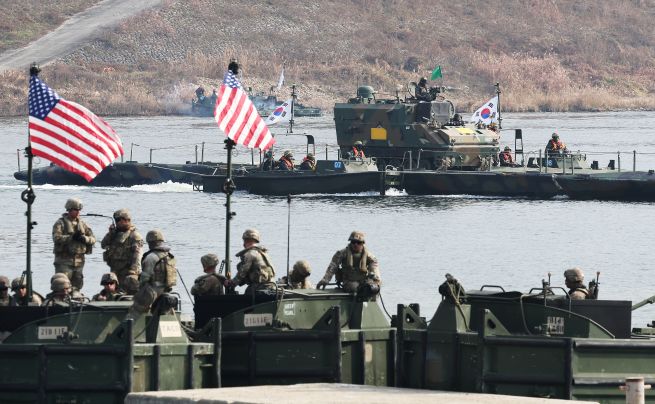
This photo, taken on Nov. 20, 2025, shows South Korean and U.S. troops engaging in a river crossing exercise in Yeoju, 64 kilometers southeast of Seoul. (Yonhap)
The emphasis on “critical” American support appears intended to reaffirm Washington’s commitment to extended deterrence, including the U.S. nuclear umbrella, analysts said. South Korea today holds a clear advantage in conventional military power over the North, whose forces rely heavily on aging equipment, but it remains dependent on U.S. strategic capabilities to counter Pyongyang’s nuclear arsenal.
In bilateral agreements released last year, the Trump administration reaffirmed that extended deterrence would draw on the full spectrum of U.S. military power, including nuclear forces.
“The strategy suggests a clear division of labor,” said Nam Chang-hee, a professor of international politics at Inha University. “South Korea handles conventional deterrence, while the United States guarantees nuclear protection.”
He added that if confidence in the U.S. nuclear umbrella were to weaken, South Korea would face stark choices: either pursuing its own nuclear capability or dramatically expanding its conventional strike forces with high-powered weapons such as the Hyunmoo-5 missile, often referred to domestically as a “monster missile” for its destructive capacity.
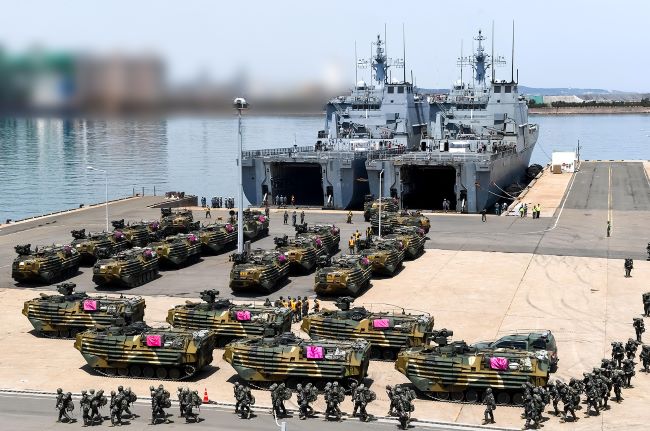
Troops wait to board amphibious landing ships at a military port in Pohang, 260 kilometers southeast of Seoul, on April 24, 2025, in this photo jointly provided by the Navy and the Marine Corps. (Yonhap)
The new strategy also revives long-running debate over the future role of the 28,500 U.S. troops stationed in South Korea. The document explicitly calls for an “upgraded” force posture on the peninsula, fueling speculation that Washington could adjust the mission, composition or deployment model of U.S. Forces Korea, traditionally an Army-centered force focused primarily on deterring the North.
Such discussions fall under what both governments have termed “alliance modernization,” a process that has gained urgency as U.S. defense officials increasingly emphasize military capabilities rather than troop numbers.
“It implies greater flexibility going forward,” Ms. Kim said. “That could include rotational deployments or shifting certain forces to other parts of the region depending on U.S. strategic priorities.”
Some analysts believe the United States may eventually reduce its ground forces in Korea while expanding air and naval assets better suited to regional contingencies, including potential crises involving Taiwan.
“My reading is that the strategy consolidates a shift toward viewing U.S. Forces Korea as part of a broader regional architecture, not solely a peninsula-focused force,” Professor Nam said. “The central question for Washington is how to manage China’s rise, not only how to deter North Korea.”
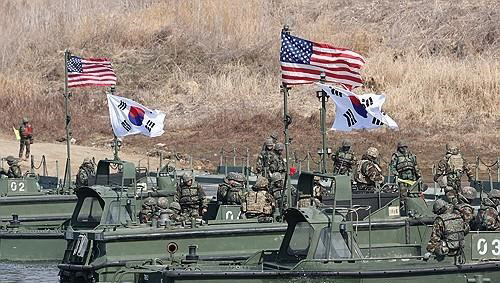
South Korean and U.S. troops engaging in a military exercise (Image courtesy of Yonhap)
The strategy’s language may also bolster President Lee’s effort to reclaim wartime operational control, known as OPCON, within his five-year term ending in 2030. South Korea and the United States have long agreed on a conditions-based transfer, requiring Seoul to demonstrate command capabilities, advanced strike and missile-defense systems, and a stable regional security environment.
“The push for greater balance in alliance responsibilities creates momentum to revisit wartime OPCON more seriously,” Ms. Kim said.
South Korea transferred operational control of its forces to the U.S.-led United Nations Command during the Korean War, later to the Combined Forces Command established in 1978. While Seoul regained peacetime control in 1994, wartime authority remains in U.S. hands.
Notably absent from the 2026 strategy, as in earlier versions, was any explicit reference to the denuclearization of North Korea. The omission has drawn attention, particularly as Mr. Trump has signaled interest in resuming diplomacy with North Korean leader Kim Jong-un.
Analysts suggested the silence may be deliberate.
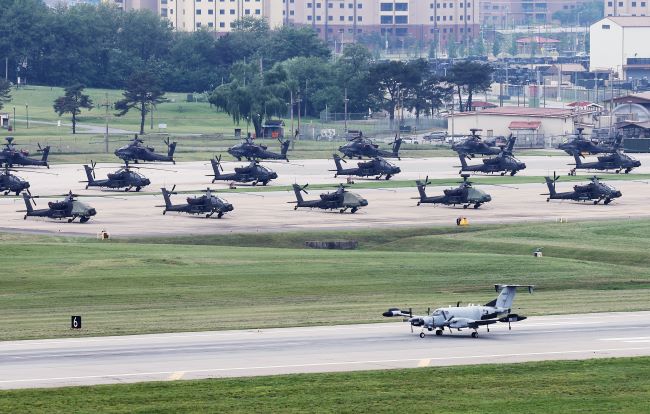
U.S. aircraft are spotted at Camp Humphreys, a U.S. military base some 65 kilometers south of Seoul, on May 23, 2025. (Image courtesy of Yonhap)
“The Pentagon may be preserving flexibility,” Professor Nam said, noting expectations that Mr. Trump could seek renewed talks with Kim when he meets Chinese President Xi Jinping during a planned visit to China in April.
Ms. Kim said the absence could also reflect internal divisions within the U.S. government or a desire to avoid foreclosing diplomatic options.
Mr. Trump has repeatedly expressed interest in reengaging with Kim, with whom he held three high-profile meetings during his first term, in Singapore, Hanoi and the Demilitarized Zone at Panmunjom.
The defense strategy, drafted under the direction of Under Secretary of Defense for Policy Elbridge Colby, places heavy emphasis on burden-sharing among allies and deterrence in the Indo-Pacific, according to Pentagon officials. Its release comes ahead of Colby’s expected visits to South Korea and Japan.
Together with the National Security Strategy issued by the White House in December, the document outlines the administration’s vision for U.S. defense policy in an era defined less by regional conflicts than by intensifying rivalry between major powers.
M. H. Lee (mhlee@koreabizwire.com)