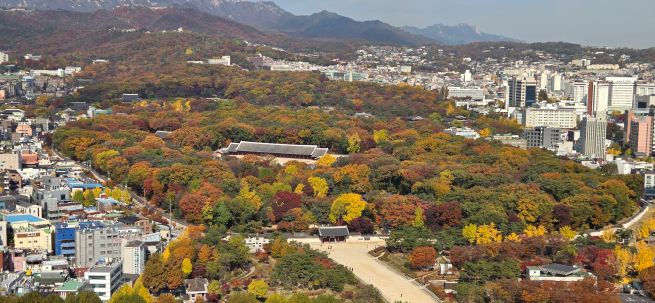
This photo, taken on November 11, shows Jongmyo Shrine in central Seoul, surrounded by tall buildings that appear to encroach on the historic site’s skyline. Landowners in Seoul’s Sewoon District 4, near the UNESCO World Heritage site Jongmyo Shrine, have pushed back against the Korea Heritage Service’s objection to the area’s redevelopment project, warning of potential legal action. The group said it would hold the agency accountable if its stance made redevelopment “impossible,” citing possible claims of administrative misconduct, damages, and abuse of authority. (Yonhap)
SEOUL, Jan. 26 (Korea Bizwire) – South Korea’s cultural heritage authority on Monday sharply criticized a decision by Seoul’s municipal government to permit high-rise construction near Jongmyo Shrine, reopening a long-simmering dispute over how to balance urban redevelopment with the protection of one of the nation’s most sacred historical sites.
The Korea Heritage Service said it had recently received a formal request for consultation from Jongno Ward, following Seoul’s move to raise the height limit in the surrounding redevelopment zone to 145 meters, roughly double the previous cap. The request is part of the administrative process required before the revised plan can proceed.
In a statement, the agency said the decision effectively dismantled a fragile compromise reached after years of negotiations among the heritage authority, the city government and the district office. It warned that the entire project should be reconsidered to prevent irreversible damage to the shrine’s historical setting.
At the center of the dispute is Sewoon District 4, a government-led redevelopment area located directly across from Jongmyo Shrine, a UNESCO World Heritage site that houses the ancestral tablets of kings and queens of the Joseon Dynasty, which ruled Korea from 1392 to 1910.
City officials argue that the redevelopment plan would rejuvenate the aging neighborhood by introducing new green spaces and modern infrastructure. Heritage authorities, however, say taller buildings could disrupt the visual and symbolic landscape surrounding the shrine, whose value lies not only in its structures but also in the spatial harmony of its surroundings.
The heritage agency also said that recent excavations at the site uncovered artifacts dating back to the Joseon era, including traces of an ancient roadway and a traditional village gate known as an imun. Under Korean law, construction cannot proceed until archaeological investigations are completed.
The Korea Heritage Service said it had suspended its review of the project after determining that the preservation plan submitted by the Seoul Housing and Urban Development Corporation lacked sufficient detail.
International scrutiny has added pressure. The UNESCO World Heritage Centre has recommended that the redevelopment be halted and that a full heritage impact assessment be conducted before any further steps are taken.
The heritage agency said it has asked the Seoul metropolitan government to respond to UNESCO’s request by Friday, warning that failure to do so could prompt an on-site inspection by UNESCO officials.
Seoul city officials, however, maintain that the redevelopment area does not fall within the legal boundary requiring such an assessment, leaving the two sides locked in a standoff that underscores the growing tension between conservation and development in one of the capital’s most historically sensitive districts.
M. H. Lee (mhlee@koreabizwire.com)