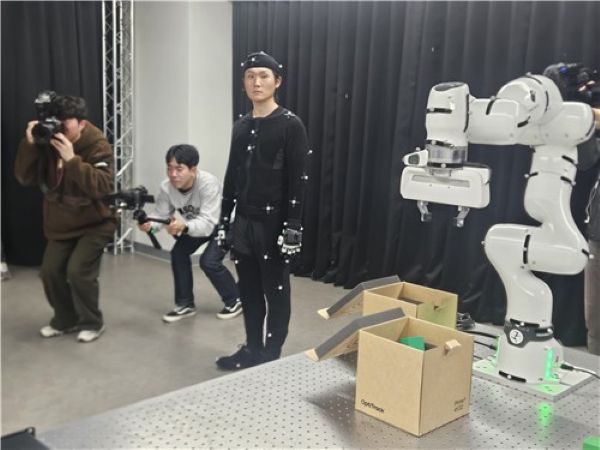
A scene showing data being collected for manufacturing AI at the “Jeonbuk National University Physical AI Demonstration Lab.” (Yonhap)
JEONJU, Jan. 27 (Korea Bizwire) — South Korea on Monday unveiled a new “physical AI” demonstration laboratory aimed at accelerating the use of artificial intelligence in manufacturing, as the government moves to strengthen the country’s industrial competitiveness amid global technological rivalry.
At the opening ceremony of the Physical AI Demonstration Lab at Jeonbuk National University, Deputy Prime Minister and Science and ICT Minister Bae Kyung-hoon pledged to support a nationwide transformation of manufacturing powered by artificial intelligence, with a particular focus on the automotive sector.
The lab is positioned as a central testing ground for Korea’s push toward so-called “AI factories,” where intelligent software systems and robots work collaboratively on production lines. From 2026 through 2030, the government plans to invest a combined 2 trillion won (about $1.5 billion) in Jeonbuk and South Gyeongsang provinces to build flagship AI-driven manufacturing models.
A separate physical AI research project launching in the first half of this year will receive 76.7 billion won in state funding, with the final budget subject to a feasibility review. The project aims to develop collaborative intelligence software that allows different types of robots to communicate, coordinate tasks and adapt to changing factory conditions.
Major technology and industrial players, including Hyundai Motor Group, SK Telecom, Naver Cloud and AI chipmaker Rebellions, are expected to participate.
Unlike conventional factory automation systems, the Jeonbuk lab emphasizes real-world verification rather than virtual simulation alone. Researchers argue that simply applying overseas AI software to Korean factories does not guarantee productivity gains without manufacturing-specific intelligence.
“The key is collaborative intelligence — enabling robots to understand each other and operate as a coordinated system,” said Kim Soon-tae, a professor at Jeonbuk National University who oversaw the lab’s development. He added that the project will also focus on software standardization, secure control systems and cybersecurity to prevent factory shutdowns.
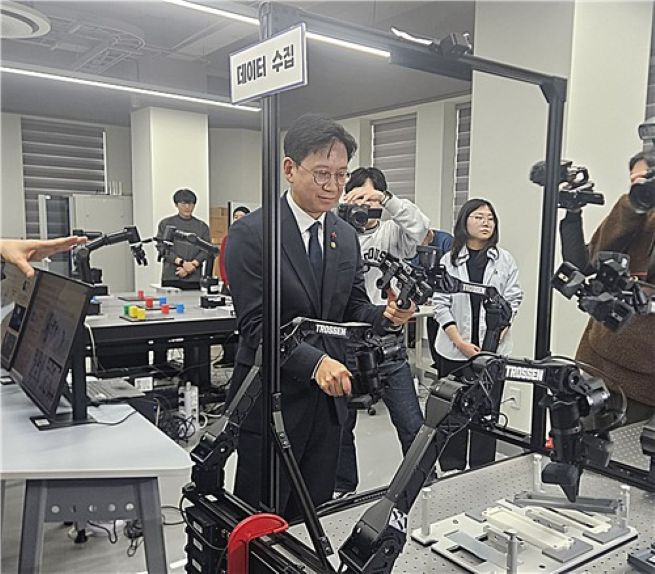
Vice Prime Minister Bae Kyung-hoon demonstrates data collection using a robotic arm at the opening ceremony of the Jeonbuk National University Physical AI Demonstration Lab. (Yonhap)
Industry participants echoed the need for manufacturing-specific AI. Hyundai Motor executive Min Jung-kuk said global AI companies increasingly recognize the value of “manufacturing context,” noting that real factory knowledge — such as how defects appear in bolts or tires — cannot be fully replicated through synthetic data alone.
Early pilot tests have already shown measurable results. Automotive parts manufacturers participating in pre-verification trials reported productivity gains of up to 11.4 percent, reductions in processing time of up to 10 percent, and cost savings reaching as high as 80 percent, even at the experimental stage.
The lab supports testing across assembly, inspection, labeling and flexible production systems, allowing researchers to evaluate both experimental and real production scenarios simultaneously. Companies including DH Autolead, Daeseung Precision and Donghae Metal have applied physical AI technologies to steering systems, braking components and vehicle body welding.
Government officials say the initiative could position South Korea as a global first mover in “manufacturing AI,” an area still largely dominated by foreign software firms.
“Applying AI to manufacturing — the field Korea knows best — is essential to raising productivity and lowering costs,” Minister Bae said, adding that the new lab provides the long-missing foundation for turning artificial intelligence into industrial competitiveness.
As global competition intensifies, Seoul is betting that combining AI with its manufacturing base will help transform the country from a producer of robots into a seller of intelligent factories themselves.
Kevin Lee (kevinlee@koreabizwire.com)