The Story Behind Korea’s Laws: Your Guide to Korea’s Legal Pulse
CHUNGJU, South Korea, Feb. 10 (Korea Bizwire) — A South Korean court is moving to repair an extraordinary mistake in a civil damages case after issuing a ruling in which the legally binding order and the written reasoning pointed in opposite directions — an error that went unnoticed for roughly six months and left the parties facing potentially severe consequences.
According to legal officials, the Civil Division of the Chungju branch of the Cheongju District Court ruled in August that one defendant, identified as C, must pay the plaintiff about 110 million won, while dismissing the claim against another defendant, B. The court read that order aloud in open court.
But the written opinion — the section explaining how the judges evaluated the evidence — reached the reverse conclusion. It found that B had committed the wrongful act and was liable for damages, while there was insufficient evidence that C had conspired in the misconduct.
Because neither the court nor the plaintiff recognized the discrepancy, no correction was requested before the case moved toward appeal. The plaintiff did not appeal. Only C appealed, because the order — the portion with enforceable legal effect — required C to pay.
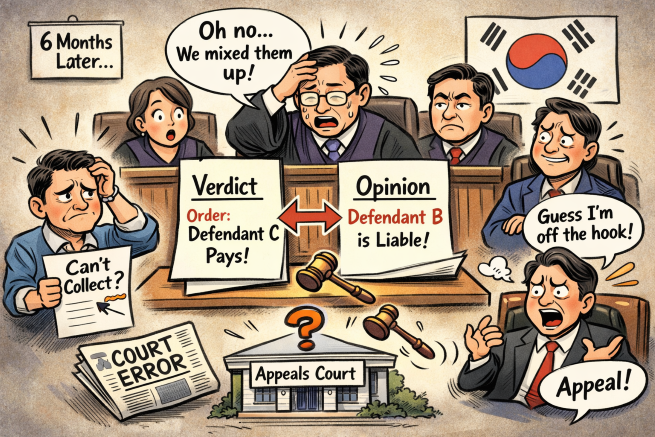
When the Order Contradicted the Opinion, Litigants Paid the Price (Image supported by ChatGPT)
B, having been cleared in the order, did not appeal, and the judgment became final as written. The consequence for the plaintiff was stark: even though the reasoning placed liability on B, the plaintiff was left without a clear path to collect from B or to pursue enforcement based on the court’s binding order.
If the appeals court ultimately accepts C’s arguments and rejects the claim, the plaintiff could end up with no recoverable damages at all.
The case proceeded to the appellate level in September, where it was awaiting scheduling for a first hearing.
Only after Yonhap News Agency formally questioned the court on Feb. 5 did the judges acknowledge the error and issue a corrective decision, notifying both sides. The court’s chief judge, Kim Ryong, called it an inexcusable lapse, noting that the case had been handled by a three-judge panel — a format meant to reduce precisely such risks.
“This is a mistake for which there is no excuse,” Judge Kim said, adding that he had never encountered a similar error in more than two decades on the bench.
The court has argued that even a finalized civil judgment can be corrected ex officio under procedural law, with the corrected text forming a single judgment together with the original.
It also said the parties may seek relief through a provision allowing “supplementary” procedural actions when deadlines were missed for reasons beyond a party’s control — potentially reopening the window for appeal based on the corrected decision.

A Judgment Miswritten, a Claim in Limbo: Court Moves Late to Correct Error (Yonhap)
Still, whether an appellate panel will treat any renewed appeal as valid remains uncertain. Defense lawyers may also argue that the late correction unfairly revives litigation they believed had already been settled.
For now, the episode has spotlighted a rare but consequential vulnerability in the judicial process: in civil cases, a few lines of miswritten text can determine not only who wins on paper, but whether anyone can collect at all.
Jerry M. Kim (jerry_kim@koreabizwire.com)