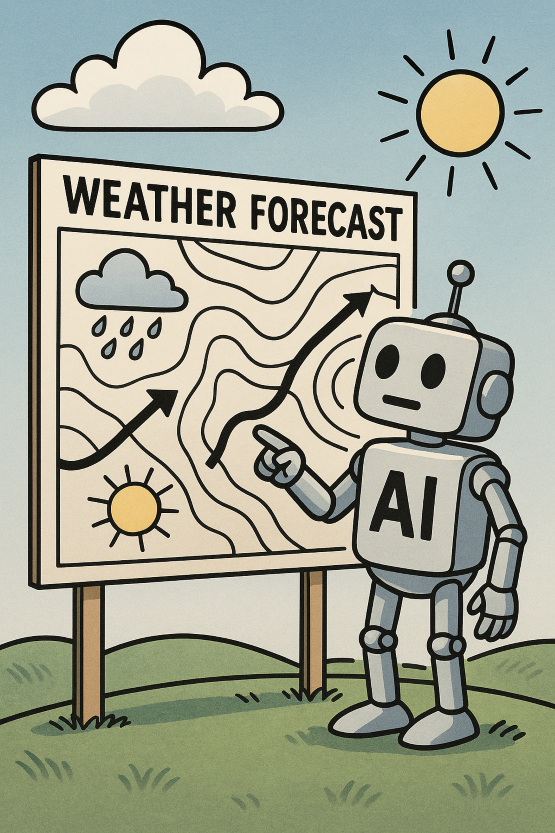
In Race Against Extreme Weather, Seoul Bets on AI Forecasting (Image supported by ChatGPT)
SEOUL, Sept. 29 (Korea Bizwire) — Artificial intelligence has already reshaped how people search for answers and make decisions. Now it is rewriting the science of predicting the weather — an area long thought too complex for machines.
At a workshop in Seogwipo, Jeju, hosted this month by the Korea Meteorological Administration (KMA) and the World Meteorological Organization, global experts agreed that AI forecasting models have moved beyond novelty.
Systems developed by Google, Huawei and Nvidia are now matching or surpassing the gold-standard European Centre for Medium-Range Weather Forecasts (ECMWF) model.
Even the ECMWF itself has adopted a hybrid AI system, AIFS, which it says outperforms traditional methods by as much as 20 percent in tracking tropical storms.
South Korea, often a follower in AI, has emerged as a leader in this niche. In May, the KMA began deploying its homegrown “NowAlpha” system, built with KAIST, to generate ultra-short-term rainfall forecasts.
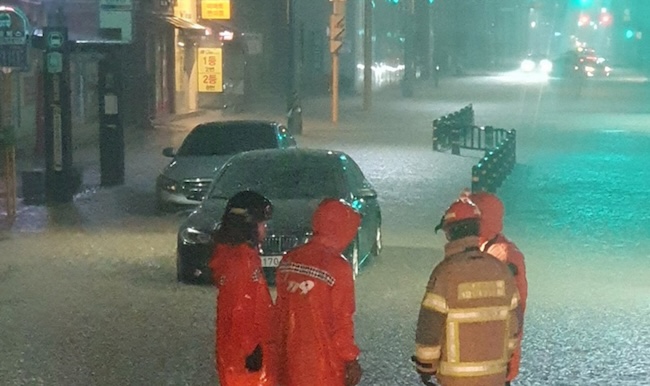
As extreme weather events such as heavy rains and heat waves become more frequent due to climate change, some consumers are considering reducing or discontinuing their use of dawn delivery services. (Image courtesy of Yonhap)
The model analyzes past radar images to predict precipitation in 10-minute intervals up to six hours ahead, a crucial window the WMO calls the “last line of defense” against extreme weather.
Unlike most countries still limited to two or three hours, NowAlpha covers the full six-hour span. Some foreign meteorological agencies have already expressed interest in adopting it.
Korean researchers recently enhanced NowAlpha using Nvidia’s “Cosmos” platform, typically applied to robotics and self-driving cars, surprising even Nvidia’s developers with its effectiveness.
The team is now preparing a medium-range AI model tailored to East Asia that could forecast weather two weeks out, with plans for a broader climate foundation model by 2029.
Officials insist that relying solely on foreign technology is risky. “Weather forecasting concerns the safety of people and property,” said Lee Hye-sook, head of AI weather research at the National Institute of Meteorological Sciences. “Without our own models, we are vulnerable if companies withdraw services or restrict improvements.”
The technology also carries global stakes. AI models require far fewer resources than traditional supercomputers, making them promising tools for developing nations that struggle with “climate inequality” — where those least responsible for global warming suffer the greatest damage. The WMO hopes to distribute the best models to poorer countries.
But Korea’s ambitions face steep hurdles. Only 15 researchers are working on the project, backed by just 96 Nvidia H100 graphics processors — a fraction of the thousands deployed by tech giants. Officials admit even securing funds to rent GPUs has been a struggle.
Despite limited resources, Korea’s experiment has positioned it alongside global heavyweights in one of the most critical applications of AI. Whether it can sustain momentum — and scale its efforts to match the climate crisis — remains an open question.
Kevin Lee (kevinlee@koreabizwire.com)