AI-Generated Video Depicting the Life of a Korean Man (Video provided by AI video production studio OutOffline)
SEOUL, June 8 (Korea Bizwire) — As artificial intelligence-generated videos reach a level nearly indistinguishable from reality, a growing chorus of concern is emerging on South Korean social media platforms, warning of the technology’s potential for deception and misuse.
A recent viral video posted to Threads, designed to raise awareness about AI-generated content, begins with a fabricated news broadcast in which an anchor reports that lava is erupting in central Seoul.
The scene cuts to a field reporter calmly standing before a digitally rendered volcanic explosion, who then reveals, “The lava behind me isn’t real — and neither am I. I’m AI.” A student, celebrity, and businessperson follow, all declaring their AI identity and warning viewers: “Don’t be fooled.”
The video, created using Google’s latest video generation model Veo 3, was produced by the YouTube creator known as “Ttakak Designer.” In an interview, the creator said they were inspired by reports of AI-driven scams using deepfakes of public figures like Elon Musk. “It was shocking to realize that even crude AI tools could deceive people,” they said.
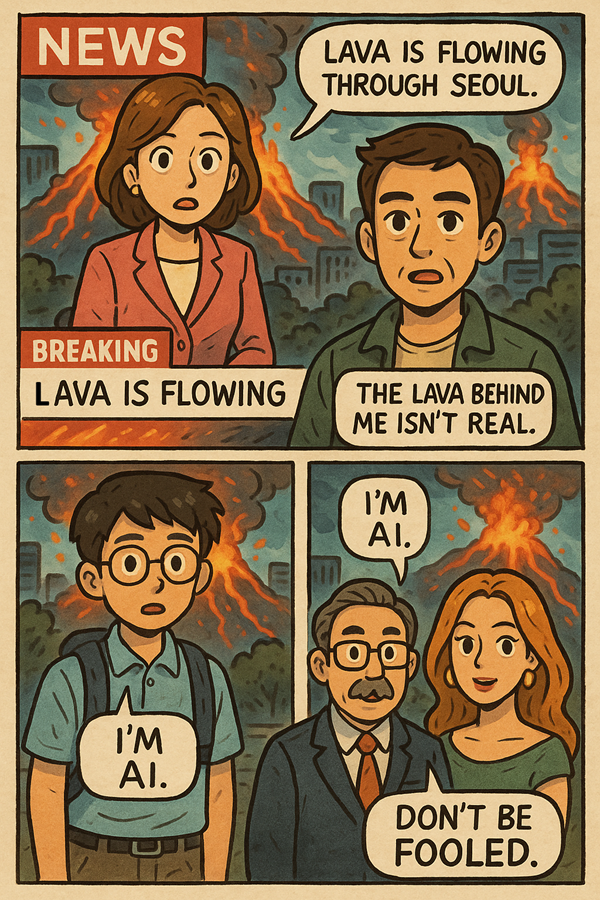
AI’s Power to Deceive: How a Fake News Clip Went Viral in South Korea (Image supported by ChatGPT)
Online responses ranged from amazement at the realism of the visuals to anxiety over how AI could be weaponized for misinformation. Some users emphasized the need to educate older generations and digital novices to help them distinguish between real and AI-generated content.
Other creators are pushing AI storytelling even further. One notable example is The Life of a Korean Man, an AI-generated short film chronicling a man’s life from childhood to old age. Produced by AI video studio OutOffline, the film drew praise for its narrative fluidity and realism, with some users predicting that creators like this could soon dominate short-form content platforms.
However, a more cynical subset of online users view AI video generation as a fast-track to monetization. “You don’t even need to film yourself anymore,” one commenter wrote, promoting prompt templates for gaining YouTube views.
AI-Generated Warning Video (Video provided by YouTuber Ttalgak Designer)
In response to the growing realism of AI content, calls for regulation and transparency are mounting. South Korea’s AI Basic Act, set to take effect in 2026, will require that all generative AI content — including films and dramas — be clearly labeled. Tech giant Naver has already introduced an “AI-generated” tag for content across its platforms, including blogs, forums, and video clips.
“Distinguishing between real and AI content is becoming harder,” Naver said in a statement. “Labeling AI-generated media is necessary to prevent confusion and clarify content origins.”
Experts agree the issue now extends beyond technology to media literacy. Choi Byung-ho, a professor at Korea University’s AI Research Institute, warned that open-source AI tools can easily be used for malicious purposes. “We need public campaigns led by media and nonprofits to teach people to ask critical questions: who made this, when, and why?” he said. “Everything should be approached with skepticism now.”
As generative AI becomes more accessible, the line between truth and fabrication continues to blur — leaving both platforms and users racing to catch up.
Kevin Lee (kevinlee@koreabizwire.com)