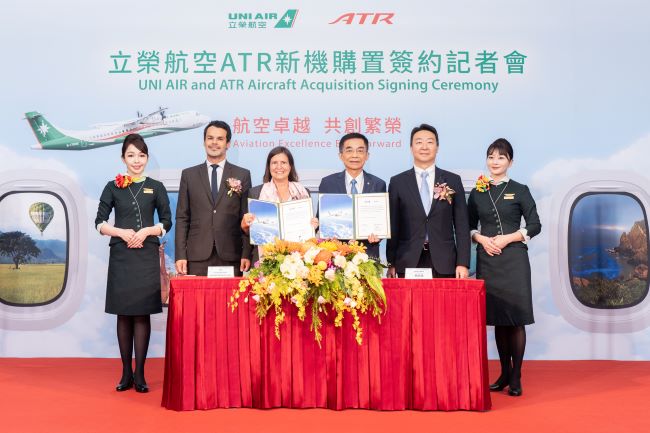
Executives of European turboprop aircraft maker ATR and Taiwan’s Uni Air hold a signing ceremony for a new aircraft supply contract at a hotel in Taipei on July 25, 2025, in this photo provided by ATR. (Yonhap)
TAIPEI, July 25 (Korea Bizwire) — European turboprop aircraft maker ATR on Friday signed a major contract with Taiwan-based Uni Air for 19 new ATR 72-600 aircraft while signaling ambitions to expand into the South Korean market.
A signing ceremony was held in Taipei to formalize Uni Air’s plans to modernize and expand its domestic fleet, particularly for operations to Taiwan’s offshore islands.
ATR is a joint venture between France’s Airbus and Italy’s Leonardo, headquartered in Toulouse, France. It specializes in turboprop aircraft, which are powered by propellers connected to turbine engines and are ideal for short-distance flights.
The ATR 72-600 is the world’s best-selling turboprop aircraft, with more than 1,900 units sold to 200 airlines.
Uni Air, a regional airline subsidiary of Eva Air, operates about 60 percent of Taiwan’s domestic air routes and plays a critical role in connecting major cities with remote island communities.
A regional airline typically operates shorter routes between smaller cities or remote areas using smaller aircraft. Unlike full-service or low-cost carriers that focus on major airports and high-traffic routes, regional aircraft play a vital role in connecting communities where rail or larger jets are impractical.
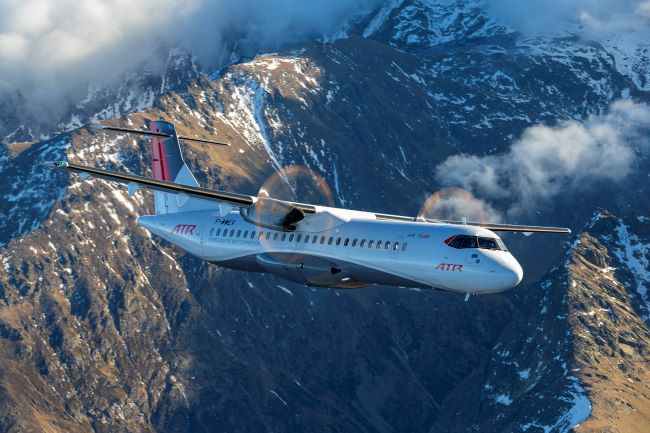
This photo, provided by ATR, shows the company’s ATR 72-600 aircraft. (Yonhap)
Nathalie Tarnaud Laude, chief executive officer (CEO) at ATR, said, “Uni Air makes a meaningful difference for the communities it serves, providing them with the frequency, reliability and connectivity they need. We are delighted to renew our strategic partnership, supporting Uni Air with its expansion plans.”
While the deal marks a major milestone for ATR in Taiwan, company officials also expressed strong interest in expanding into South Korea’s short-haul regional aviation market.
Alexis Vidal, senior vice president and chief commercial officer at ATR, told Yonhap News Agency at the signing ceremony that the company sees South Korea as a promising market for regional turboprop operations.
“In Korea, we will be very excited to provide new ATR 72-600s to better connect the country, notably between east and west or the islands with new airports, or even the short-haul international demand for passenger transport,” Vidal said.
He hinted ATR is actively engaging with stakeholders in South Korea, including airlines, regulators and government ministries, although he declined to specify the details of any ongoing discussions.
When asked about the challenges of entering the Korean market, Vidal said the goal is not to compete with existing infrastructure but to fill a gap.
“I don’t know if it’s a challenge, but it’s about complementing the current ground infrastructure and larger narrow-body aircraft, and showing that a 72-seat-capacity ATR aircraft with the right economics is the best adaptive platform for transporting passengers,” he said.
“I would call it an opportunity for us to bring a better service for Korea.”
Vidal also estimated that demand in South Korea could support up to 30 ATR aircraft.
“I believe there is a demand for 25 to 30 ATR units in the country, and we will be thrilled to start commencing 2026 with operations with our launch operator,” said Vidal, referring to South Korean regional startup airline Sum Air Co.
ATR has already established a strong footprint in the Asia-Pacific region, with over 100 aircraft in Indonesia, more than 70 in India and growing fleets in Japan, Malaysia and Taiwan.
The company currently holds an order backlog of more than 180 aircraft, with nearly half of recent orders coming from Asia-Pacific operators.
(Yonhap)