China Invites Lee Jae-myung to WWII Anniversary Event, Testing Seoul’s Diplomacy (Image supported by ChatGPT)
SEOUL, July 2 (Korea Bizwire) — In a move that could become the first major diplomatic test of President Lee Jae-myung’s nascent administration, China has approached South Korea about his potential attendance at a military parade this September, commemorating the 80th anniversary of its World War II victory over Japanese aggression.
Diplomatic sources revealed Wednesday that Beijing has floated the idea of Lee’s participation through multiple informal channels. A formal invitation has yet to be extended, but the outreach already places the South Korean leader at the intersection of escalating strategic tensions between Washington and Beijing.
Scheduled for September 3 in Beijing’s Tiananmen Square, the military parade is expected to be a high-profile affair, with reports suggesting that Chinese officials are also weighing an invitation to U.S. President Donald Trump. Should both leaders be present, the optics could be politically explosive—particularly for Seoul.
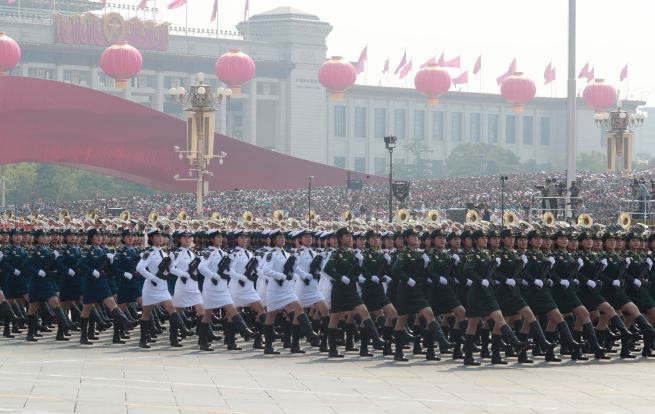
China’s 70th Anniversary Military Parade in 2019 (Yonhap)
Inside Lee’s administration, the idea is under review. “There are many factors to take into consideration,” a foreign ministry official said, indicating that the decision hinges on a complex matrix of timing, precedent, and geopolitical signaling.
President Lee, who has previously expressed views seen as sympathetic to Beijing, has sought to allay concerns in Washington by reaffirming his commitment to the U.S.-South Korea alliance and expressing support for deepening trilateral cooperation with the United States and Japan.
Since taking office on June 4, he has been working to schedule his first bilateral summit with President Trump, a meeting that could happen as early as later this month.
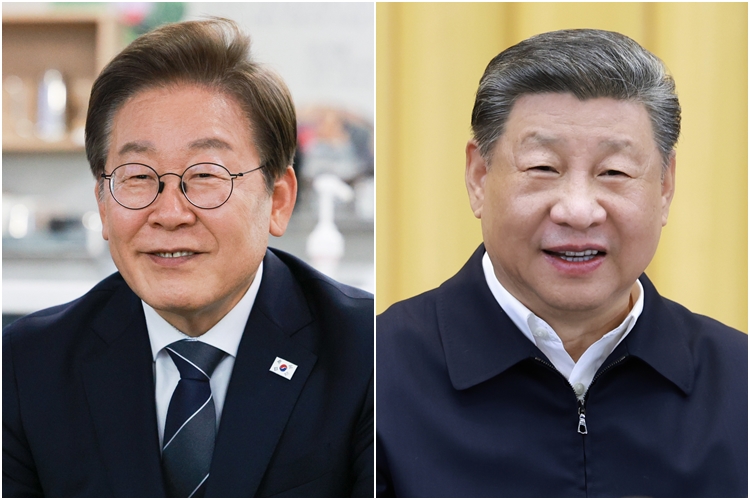
President Lee Jae-myung (left) and Chinese President Xi Jinping
A decision to attend the Beijing parade, particularly ahead of such a meeting, could raise eyebrows in Washington and potentially complicate Lee’s early efforts to position himself as a steady partner in the Indo-Pacific.
Yet Lee’s calculus may also include managing South Korea’s economic and strategic relationship with China—still its largest trading partner—and anticipating a visit by Chinese President Xi Jinping to the Asia-Pacific Economic Cooperation (APEC) summit in South Korea later this year.
Observers point to historical precedent. In 2015, then-President Park Geun-hye faced similar pressures and ultimately chose to attend the same Chinese military parade. That decision, made against the backdrop of Washington’s unease, was meant as a diplomatic overture to encourage China’s role in restraining North Korea’s nuclear ambitions.
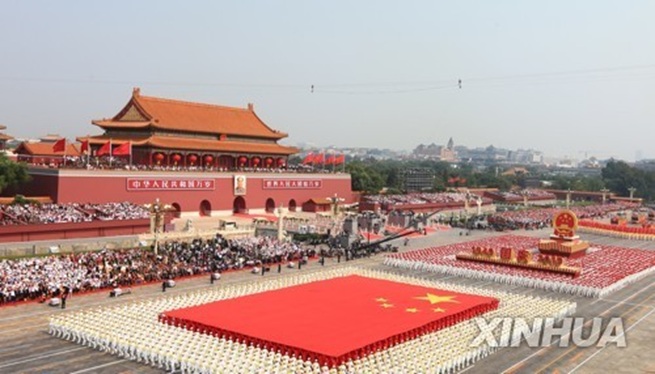
This file photo, released by China’s Xinhua news agency, shows a celebration marking the 70th anniversary of the founding of the country in Beijing on Oct. 1, 2019.
Instead, Pyongyang detonated its fourth nuclear device the following year, and Seoul’s deployment of a U.S. missile defense system triggered sweeping economic retaliation from Beijing.
Now, nearly a decade later, President Lee stands at a familiar but even more fraught crossroads—one where symbolism, timing, and alliance politics converge. Whether he accepts China’s unofficial invitation may not only define his foreign policy approach but also send a powerful signal about where South Korea sees its place in a world increasingly divided between two superpowers.
M. H. Lee (mhlee@koreabizwire.com)