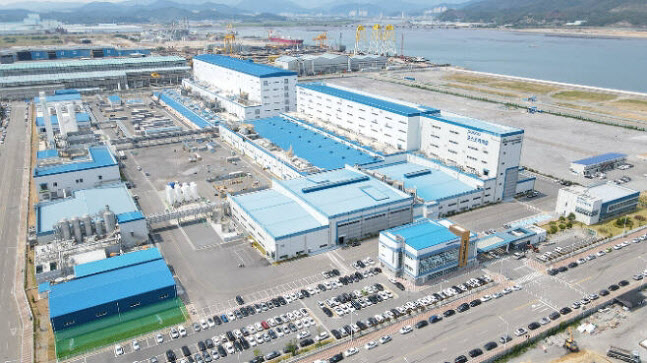
Aerial view of POSCO Future M’s Gwangyang Anode Material Plant in Jeonnam, South Korea (Image courtesy of Posco FutureM)
SEOUL, May 22 (Korea Bizwire) — China solidified its near-total dominance of the global lithium-ion battery anode materials market in 2024, pushing South Korea’s POSCO Future M out of the global top 10 amid intensifying price competition and overproduction.
According to data released Tuesday by SNE Research, global demand for anode materials reached 1.97 million tons last year, with shipments totaling 2.11 million tons — up 26% and 25% respectively from 2023.
Artificial graphite accounted for the vast majority of shipments at 1.76 million tons, or roughly 83%, followed by natural graphite at 290,000 tons (14%) and silicon-based anodes at 41,000 tons (1.9%).
The top 10 anode suppliers by shipment volume were all Chinese companies. Market leader BTR shipped more than 432,000 tons, followed by Shanshan (340,000 tons), Shenzen XFH Technology (213,000 tons), Shanghai Shanshan (208,000 tons), and Kaijin (158,000 tons). Together, the top 10 firms commanded a combined market share of approximately 84%.
Non-Chinese firms, particularly from South Korea and Japan, struggled to compete amid China’s aggressive underpricing and expanded production. POSCO Future M, once ranked sixth globally in 2020, fell to 11th place in 2024 with 27,200 tons shipped — down from 10th the previous year.
The Korean firm was hit by a confluence of setbacks, including a temporary demand slowdown in the electric vehicle market — referred to as the “EV chasm” — and disruptions caused by U.S. restrictions on Chinese-sourced graphite, which reshaped global supply chains. The company also struggled to match the cost competitiveness of Chinese graphite products.
Japanese manufacturer Resonac also scaled back production, ceasing operations at graphite electrode facilities in China and Malaysia. It has taken a more cautious stance toward expanding its lithium-ion battery anode business.
Looking ahead, SNE Research projects Chinese artificial graphite will maintain its lead in 2025, with major players like BTR and Shanshan continuing to dominate. However, the firm also anticipates increased interest in next-generation materials such as silicon-based anodes and hard carbon for sodium-ion batteries, which could gradually reshape the market landscape.
Kevin Lee (kevinlee@koreabizwire.com)