The Story Behind Korea’s Laws: Your Guide to Korea’s Legal Pulse
SEOUL, Dec. 2 (Korea Bizwire) — South Korea’s Constitutional Court has upheld an Army regulation that restricts officers’ off-base leave to areas from which they can return to their unit within two hours, ruling the policy constitutional amid longstanding security concerns on the peninsula.
In a unanimous decision delivered Nov. 27, the court rejected a petition filed by a former first lieutenant who argued that the 35th Infantry Division’s barracks-life guideline violated his freedom of movement and general freedom of action. Although the petitioner has since left the service, the court proceeded with the case, noting that similar rules remain in place across multiple units.
The court said the regulation does not impose excessive limits, citing advances in transportation and communications that have expanded what constitutes a two-hour radius. It also emphasized the division’s status as an operational unit, whose officers must be able to return quickly to lead troops in emergencies.
“Given South Korea’s geopolitical realities—facing North Korea and surrounded by major powers—the public interest in ensuring national security far outweighs any restriction on the petitioner’s freedoms,” the court wrote. It added that commanders must retain the ability to secure sufficient personnel at all times.
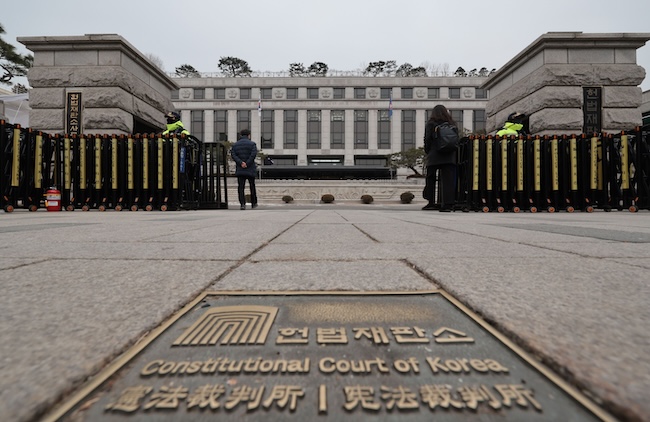
The Constitutional Court in Seoul (Image courtesy of Yonhap)
The petitioner also argued that the rule exceeded the scope of authority delegated by higher law, which permits leave restrictions only “in wartime, emergencies or comparable national crises.” But the court noted that South Korea remains in a technical state of armistice, with frequent military incidents in border areas, and that operational readiness is required even in peacetime.
“Peacetime cannot be categorically excluded from circumstances requiring rapid response,” the court said, concluding that limiting leave zones does not breach the principle that restrictions on rights must be grounded in statute.
The ruling affirms long-standing practice within the Army and signals strong judicial deference to national-security considerations at a time of heightened regional tensions.
Jerry M. Kim (jerry_kim@koreabizwire.com)