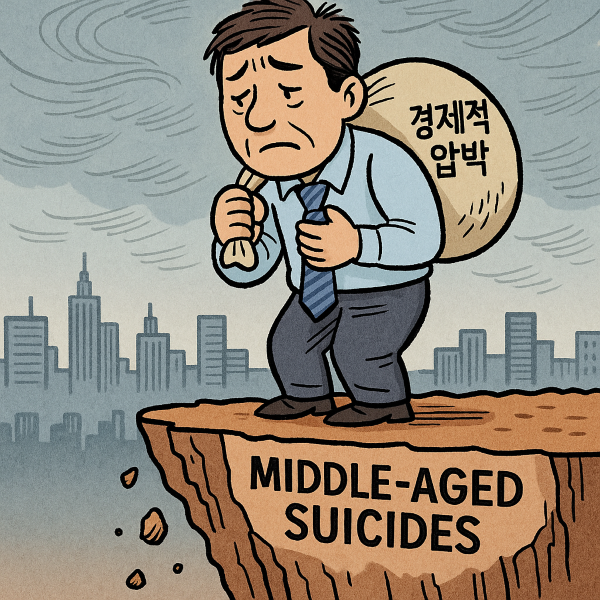
South Korea’s Middle-Aged Workers Face Rising Suicide Rates (Image supported by ChatGPT)
SEOUL, Sept. 29 (Korea Bizwire) — Suicide has overtaken cancer as the leading cause of death for South Koreans in their 40s, underscoring the intensifying pressures on the country’s core working-age population, according to new government data.
Figures released by Statistics Korea show that South Korea’s overall suicide rate rose to 29.1 deaths per 100,000 people in 2024, up 6.6 percent from the previous year and the highest level since 2011. The country continues to post the world’s highest suicide rate.
The increase was particularly pronounced among middle-aged adults. The suicide rate among people in their 30s jumped nearly 15 percent to 30.4 per 100,000, while rates climbed 14.7 percent for those in their 40s and 12.2 percent for those in their 50s.
By contrast, the rate rose only modestly among people in their 20s and 60s. Experts say the sharp increase among adults in their prime earning years reflects mounting financial pressures and intensifying social competition.
Gender disparities remain stark. Men accounted for more than two-thirds of the 14,872 suicides recorded last year. Among middle-aged adults, the gap widened: suicide rates among men in their 40s reached 51.1 per 100,000, compared with 20.9 for women.
Analysts note that while men are more likely to cite economic hardship as a trigger, women more often report mental health struggles.
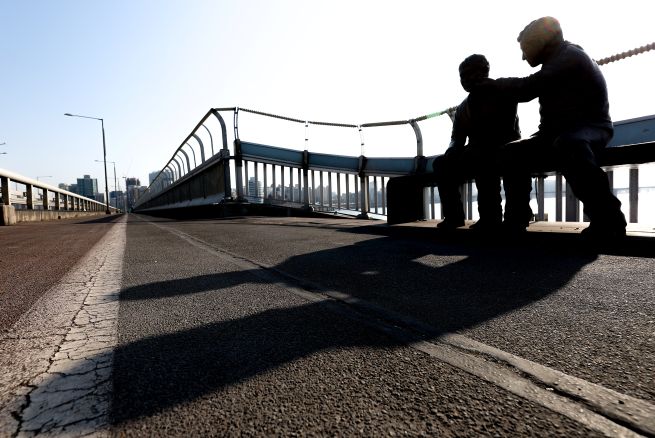
View of the “Just One More Time” statue installed at the mid-observatory section of Mapo Bridge in Seoul. The statue depicts a man in despair being comforted by another man pinching his cheek. Installed in 2012 as part of the “Bridge of Life” project, it carries the message, “My friend, think it over just one more time,” serving as a symbolic space for suicide prevention. (Yonhap)
“Ultimately, this is about livelihoods,” said Park Jong-ik, a professor at Kangwon National University. “Rising suicide rates among working-age people reflect the reality that economic strain translates directly into despair.”
The Ministry of Health and Welfare also cited job loss, retirement, debt, divorce, celebrity suicides, and gaps in regional mental health resources as contributing factors.
Scholars argue that South Korea’s persistently high suicide rate is not merely a matter of individual mental health but a structural crisis tied to inequality.
“Despite remarkable economic growth, failures to address economic and gender inequality have left many middle-aged adults labeling themselves as failures, leading to tragic outcomes,” wrote Choi Myung-min, a professor at Baekseok University, in a 2023 study.
While public attention often focuses on youth suicides, experts stress the need for equal concern over middle-aged adults, many of whom shoulder heavy financial and family responsibilities in silence.
Preventing such deaths, they say, will require dismantling the social and economic conditions that drive people to the brink — and ensuring that those who feel alone know they are not.
Lina Jang (linajang@koreabizwire.com)