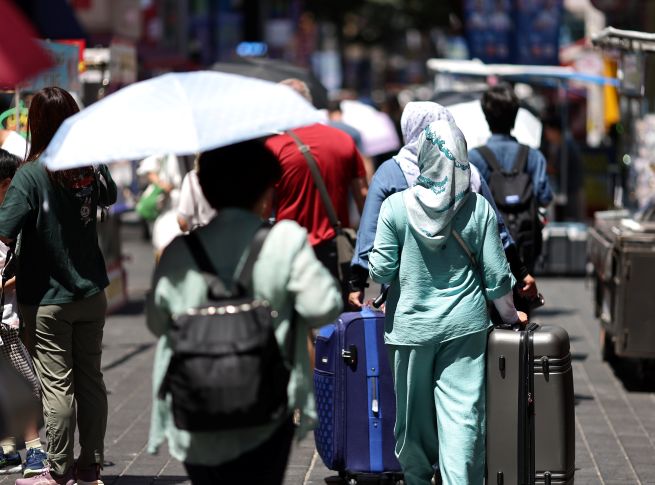
The number of foreign nationals residing in South Korea for purposes such as study, work, or tourism has surpassed 2.73 million, marking an all-time high. According to the Immigration Policy Division of the Ministry of Justice on July 27, the total number of foreign residents in the country stood at 2,732,797 as of the end of June, up 1.5% (40,068 people) from the previous month. (Yonhap)
SEOUL, July 27 (Korea Bizwire) — South Korea’s foreign resident population has reached a historic peak, surpassing 2.73 million as of the end of June, according to new data released by the Ministry of Justice on Sunday.
The number of foreign nationals staying in the country for education, work, tourism, or other purposes stood at 2,732,797—an increase of 1.5% (about 40,000 people) from the previous month. This figure includes both long-term residents and short-term visitors, such as tourists.
Of the total, 1.56 million were registered long-term residents, while 552,419 were ethnic Koreans holding foreign nationality with domestic residence permits. Short-term visitors, including tourists, accounted for roughly 620,000.
The foreign population had previously peaked at 2.52 million in 2019 before declining for two consecutive years amid the COVID-19 pandemic. Numbers dropped to around 2.04 million in 2020 and further to 1.96 million in 2021.
Since the pandemic subsided, the numbers have steadily rebounded, hitting 2.65 million last year and reaching a record high this June after slight dips in April and May.

On the afternoon of July 13, 2023, at HanHakChon in Keimyung University, Dalseo-gu, Daegu, foreign students participating in the ‘2023 Korean Language and Culture Camp’ learned traditional tea ceremony etiquette while dressed in Hanbok. (Yonhap)
By nationality, Chinese citizens made up the largest share at 972,176 people (35.6%), followed by Vietnamese (341,153), Americans (196,664), Thais (173,710), and Uzbeks (98,457).
Most registered foreign residents are concentrated in the greater Seoul area, while the southeastern Yeongnam region accounts for about 20.3% of the total. The Chungcheong and Honam regions followed with 12.9% and 8.8%, respectively.
In terms of age, the largest demographic groups were individuals in their 30s (25.7%) and 20s (23.1%), followed by those in their 40s (16.7%).
By visa type, ethnic Koreans on F-4 visas made up the largest group at 554,895, while 341,453 held E-9 non-professional work visas issued under South Korea’s Employment Permit System. Other major categories included F-5 permanent residents (214,036), D-2 student visa holders (191,297), and B-2 transit/tourist visa holders (171,063).
The number of tourists rose sharply, increasing 29.6% from the previous month, underscoring South Korea’s continued recovery as a destination for global travelers.
Lina Jang (linajang@koreabizwire.com)