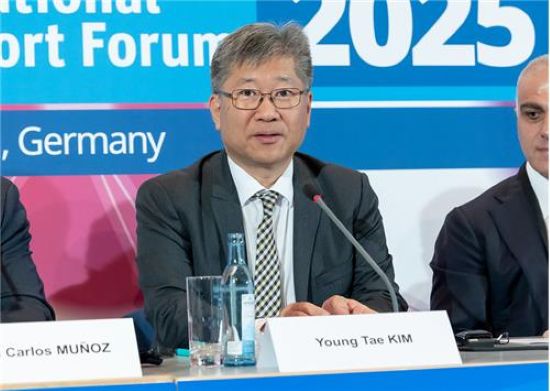
This photo provided by the International Transport Forum (ITF) shows Kim Young-tae, secretary general of the international organization, speaking at the 2025 ITF Summit at the Congress Center in Leipzig, Germany.(Yonhap)
LEIPZIG, Germany, May 23 (Korea Bizwire) — Intensifying trade uncertainties, including tariff wars, have a great impact on the global transport industry, which has no choice but to “adapt” to the changed situation, the chief of the inter-organizational transport body said Friday.
“(The global trade war) has an impact on what kind of goods we transport, causing big shifts in items transported from one country to another,” said Kim Young-tae, Secretary General of the International Transport Forum (ITF), in a group media interview at the 2025 ITF Summit in the eastern German city of Leipzig.
“We have no choice but to adapt to different situations in the global environment as we are transporting goods and people,” Kim said, explaining that tariffs affect the supply and demand of goods for trade, such as automobiles.
Kim said geopolitical tensions can also disrupt and restructure maritime trade routes, referring to yearslong tensions in the Red Sea, one of the world’s most vital waterways in the Middle East.
The Donald Trump administration slapped hefty “reciprocal” tariffs on its trading partners, including 25 percent duties for South Korea, in early April, only to pause them for 90 days. Washington has also imposed sectoral tariffs, including 25 percent levies on all steel and automobile imports.
According to a report from global maritime consultancy Drewry, these U.S. trade policies are forecast to lead to a 1 percent drop in global container shipping volume in 2025.
“We are attentively monitoring the situation … and taking into account the trade and climate change issues to make projections on the growth of the transport industry,” he added.
The annual ITF summit was set to wrap up its three-day run Friday after global transport leaders from more than 80 countries across the world, including South Korea and the Unites States, gathered to discuss measures to boost transport resilience to global shocks.
Transport ministers of member nations of the ITF adopted policy recommendations on comprehensive road safety policy and the use of artificial intelligence (AI) by transport authorities.
A recommendation on the decarbonization efforts of the transport industry was discussed but not adopted due to opposition from the U.S., according to Kim.
In the summit, South Korean Transport Minister Park Sang-woo shared South Korea’s efforts to promote the use of public transportation and the transition to electric vehicles (EVs) for reducing carbon emissions, according to Park’s office.
Asked about how the private transport sector can incorporate AI into their businesses amid differences by country in terms of standards on “safe” and “responsible” use of the technology, Kim said the ITF’s policy recommendation may serve as a guideline on the international community’s direction on the matter.
“We need clear guidance and clear information on where we are going, and our policy recommendation on AI can be an input to productive regulations for the European Union and the United Nations,” he said.
(Yonhap)