Regional Inequality Persists in Korea’s Living Wage System
SEOUL, Jan. 28 (Korea Bizwire) — Gwangju emerged as South Korea’s highest-paying region under the country’s living wage system this year, offering a monthly wage of about 2.78 million won, according to a nationwide survey released Wednesday by the Korean Confederation of Trade Unions.
The findings, based on a comprehensive review of living wage policies for 2026, highlight widening regional disparities in pay levels designed to ensure a basic standard of living for public-sector workers and their families.
Gwangju’s living wage was set at 13,303 won per hour — nearly 29 percent higher than the national minimum wage of 10,320 won for 2026. It was followed by Gyeonggi Province, North Jeolla, South Jeolla and Busan.

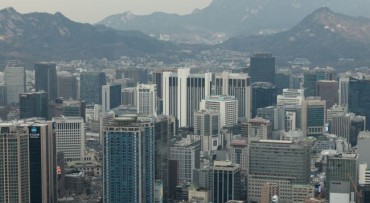
Visitors to Seoul’s Namsan Observatory look out over a cityscape packed with apartment buildings. (Yonhap)
By contrast, Seoul ranked only ninth among the country’s 17 metropolitan governments, with a monthly living wage of about 2.53 million won, despite having the nation’s highest housing costs and strongest fiscal base. Incheon recorded the lowest living wage among metropolitan regions, at 12,010 won per hour — about 270,000 won less per month than Gwangju.
For the first time, however, all metropolitan governments set their living wages above 12,000 won per hour, marking a symbolic threshold in the policy’s expansion.
Unlike the legally mandated minimum wage, the living wage is a recommendation adopted through local ordinances. It applies primarily to public-sector employees and is encouraged in public contracts, with wage levels determined independently by each local government and education office.
The survey found that only 132 of 260 eligible public institutions nationwide — just over half — have implemented a living wage policy. While all 17 metropolitan governments participate, adoption remains uneven among provincial education offices and local municipalities, where implementation rates remain below 50 percent.

Citizens are shopping at the E-Mart Food Market Godeok branch in Gangdong District, Seoul. (Yonhap)
Living wages also tended to be higher at the metropolitan level than at the municipal level. The average hourly living wage for metropolitan governments was 12,233 won, compared with 11,805 won for basic local governments — a gap the labor group attributed to differences in fiscal stability.
The Korean Confederation of Trade Unions said it plans to hold discussions and policy forums this year aimed at narrowing regional disparities and encouraging broader adoption of the living wage system, as debates over income security and cost-of-living pressures continue to intensify nationwide.
Lina Jang (linajang@koreabizwire.com)