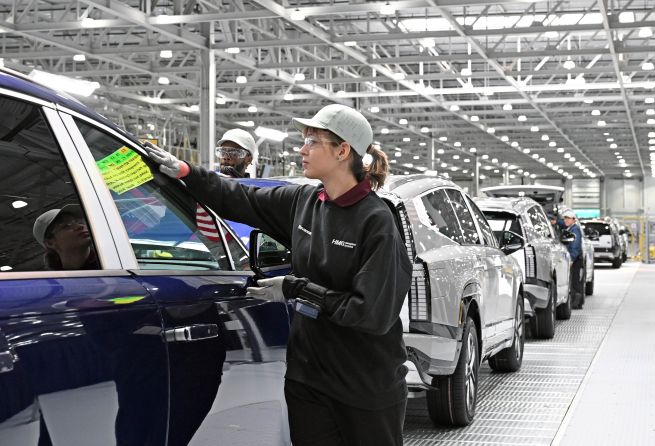
A view of the production line at Hyundai Motor Group Metaplant America (HMGMA) in Georgia, U.S. (Photo courtesy of Hyundai Motor Group)
SEOUL, July 28 (Korea Bizwire) — Hyundai Motor’s move to localize auto parts production in the United States in response to steep U.S. tariffs is casting a shadow over South Korea’s auto parts industry, sparking concerns of declining exports and weakened domestic supply contracts.
In its second-quarter earnings call on July 24, Hyundai confirmed it is actively reviewing supply chain restructuring, stating it will “pursue strategic local sourcing of parts through a company-wide collaborative framework.” A task force is reportedly evaluating optimal procurement options for over 200 components.
The shift comes as tariffs under former President Donald Trump’s trade policy sharply dented Hyundai’s quarterly profitability. The company said it suffered 828.2 billion won (approx. $600 million) in lost operating profit due to tariffs, with 20% of that directly tied to parts imports.
Sister company Kia also saw its operating profit reduced by 786 billion won for similar reasons, suggesting the entire Hyundai Motor Group is moving in the same direction.
According to the Korea Institute for Industrial Economics and Trade, Hyundai and Kia’s U.S. local parts sourcing rate stands at just 48.6%—notably lower than competitors like Tesla (68.9%), Honda (62.3%), and Toyota (53.7%).
“It’s only natural that Hyundai shifts more of its supply chain locally to maintain price competitiveness,” said one industry insider, underscoring fears of fallout for Korean suppliers.

Tariff Fallout: Hyundai to Shift Parts Sourcing to U.S., Raising Concerns at Home (Image supported by ChatGPT)
Last year, South Korea exported a record $8.22 billion worth of auto parts to the U.S., with an estimated 60–70% of those destined for Hyundai and Kia. If the group’s U.S. localization plans accelerate, Korean suppliers risk losing their largest overseas customer.
“Many of these firms, already struggling with the costly transition to next-generation vehicles, now face a double or even triple blow,” said Lee Hang-gu, former head of the Korea Automotive Technology Institute.
Further concern surrounds Hyundai’s expanding U.S. manufacturing footprint. The automaker plans to increase annual production capacity at its Georgia-based Hyundai Motor Group Metaplant America (HMGMA) from 700,000 to 1.2 million vehicles.
Without tariff relief, the shift of vehicle assembly to the U.S. could lock in local parts sourcing, reducing domestic suppliers’ export volumes.
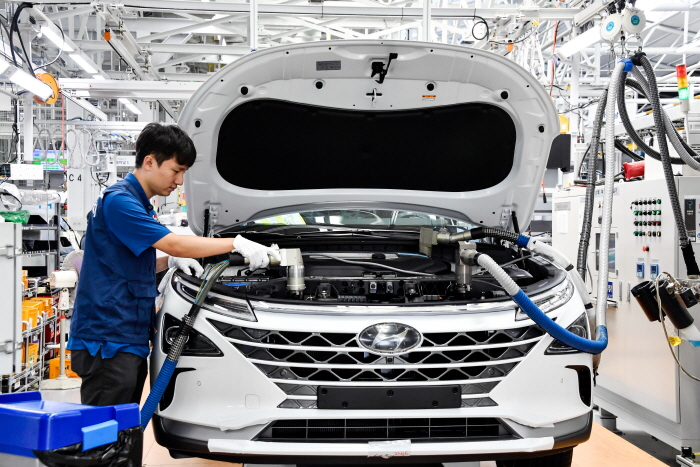
Production line of Hyundai Motor’s hydrogen fuel cell vehicle, NEXO. (Photo courtesy of Hyundai Motor)
South Korean parts makers are particularly vulnerable due to their heavy reliance on Hyundai and Kia, which together accounted for over 90% of total supplier contracts—worth 71.7 trillion won—in 2023.
“If Hyundai’s U.S. production scales up, fewer vehicles will be assembled in Korea, and that inevitably means lower sales and order volumes for domestic parts makers,” another industry source warned.
Kevin Lee (kevinlee@koreabizwire.com)