
The City of Seoul (Image courtesy of Yonhap)
SEOUL, June 25 (Korea Bizwire) — Nearly eight out of ten of South Korea’s largest companies are clustered in the greater Seoul area, highlighting a deepening imbalance in the nation’s corporate geography — one that’s reigniting debate over regional development and decentralization.
According to a recent report by market research firm CEO Score, 385 out of the country’s top 500 companies by revenue — or 77 percent — are headquartered in Seoul, Incheon, or Gyeonggi Province.
The disparity is stark: while the capital region continues to attract business giants, only one company each is headquartered in the administrative city of Sejong and the eastern province of Gangwon.
This concentration is drawing renewed attention as the newly inaugurated administration of President Lee Jae-myung pushes to move key institutions, including the Ministry of Oceans and Fisheries, to Busan.
The proposal has also reopened talks of relocating the headquarters of HMM, South Korea’s leading shipping company, to the southern port city.
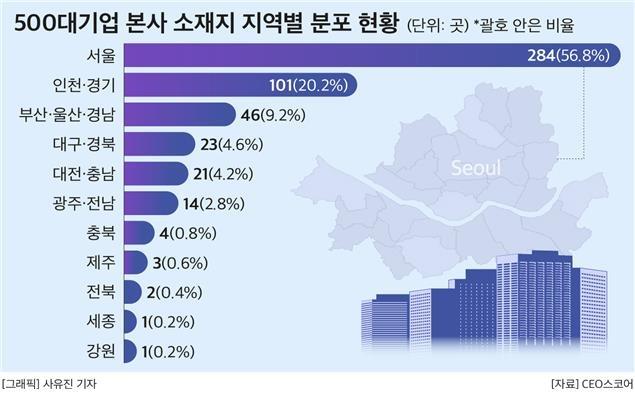
This graphic, provided by market tracker CEO Score, shows the headquarters locations of South Korea’s top 500 companies. (Yonhap)
Seoul’s dominance is no accident. Titans like Samsung Electronics, Hyundai Motor, and SK hynix have long called the region home, drawn by infrastructure, talent pools, and proximity to political power. Yet the imbalance poses growing challenges, especially as rural areas face demographic decline and economic stagnation.
Public enterprises have been the exception. Policies aimed at decentralization have led to a more even distribution of state-run companies across provincial cities. Of the 22 public firms included in the top 500, 17 are based outside the capital region — a stark contrast to their private-sector counterparts.
“Provincial governments that host major company headquarters benefit immensely — not only in tax revenue, but also in employment and local economic growth,” CEO Score noted. “This report serves as yet another reminder of how concentrated corporate power remains, even as the need for balanced regional development becomes increasingly urgent.”
Ashley Song (ashley@koreabizwire.com)