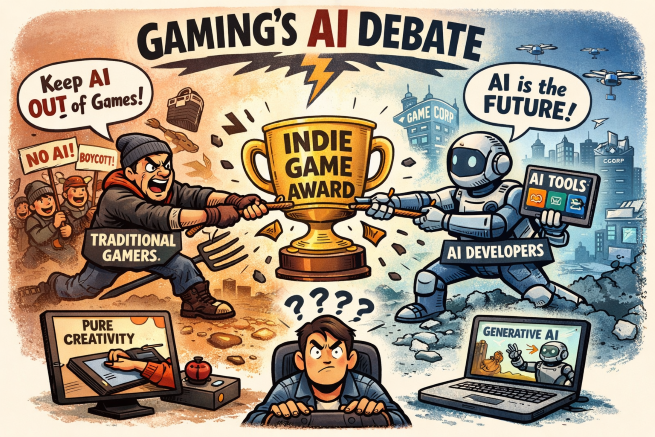
When AI Enters the Game: A Growing Backlash Challenges the Industry’s Creative Rules (Image supported by ChatGPT)
SEOUL, Dec. 28 (Korea Bizwire) — Games built with generative artificial intelligence are facing a growing backlash from players and critics, exposing a widening fault line in the global gaming industry over how far AI should be allowed to shape creative work.
The debate flared anew after the Independent Games Awards (IGA), a prominent indie game prize based in France, abruptly revoked an award it had granted to Clair Obscur: Expedition 33, developed by French studio Sandfall Interactive. The decision came shortly after the game swept nine categories at The Game Awards, one of the industry’s most prestigious ceremonies.
IGA officials said the revocation was prompted by revelations that generative AI had been used during development. The game’s producer, François Meurisse, had previously acknowledged in an interview that AI tools were used “sparingly.” But IGA rules prohibit games developed with AI from being nominated, and Sandfall Interactive was reported to have declared no AI usage during submission.
Although the studio said it had removed AI-generated assets after the controversy surfaced, the awards body rejected the explanation, citing concerns about preserving the “purity” of indie game development.
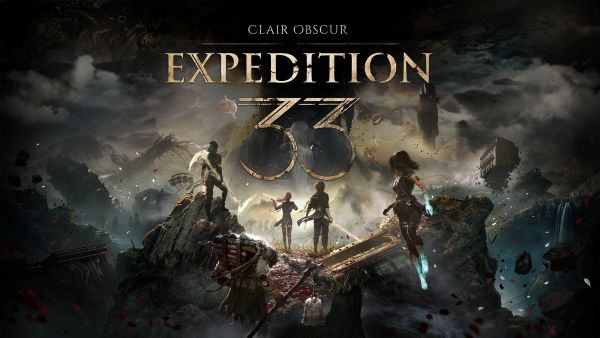
“Clair Obscur: Expedition 33” (Image courtesy of Sandfall Interactive)
The episode reignited a long-simmering dispute within gaming communities. Critics argue that AI-assisted games dilute human creativity and exploit uncredited training data, while some players have called for mandatory disclosure labels and even consumer boycotts. Others counter that such resistance is unrealistic in an industry where AI tools are becoming ubiquitous.
Major platforms have taken divergent approaches. Valve’s Steam now requires developers to disclose whether AI was used in game development or content creation. Epic Games, a rival platform, has pushed back sharply.
Its chief executive, Tim Sweeney, dismissed Steam’s stance as impractical, arguing that AI will soon be embedded in nearly all forms of digital creation.
Industry data underscores his point. A Google Cloud survey released in August found that 87 percent of game developers across five countries, including South Korea and the United States, already use AI in some part of their workflow.

AI features integrated into Adobe Photoshop (Image courtesy of Adobe)
For indie studios facing chronic shortages of time, funding and manpower, AI tools are often not optional but essential. In South Korea, the national indie developers’ association even renamed itself this year to emphasize artificial intelligence.
As AI tools spread across art generation, coding, animation and audio, the boundary between “AI-made” and “human-made” games has grown increasingly blurred. Widely used software such as Adobe Photoshop, Unreal Engine and Unity now integrate AI-powered features by default, raising questions about whether any modern digital creation can truly claim to be AI-free.
Some industry veterans have likened the moment to the early backlash against computer-generated imagery in film. When Tron debuted in 1982, the Academy Awards refused to recognize its visual effects, arguing that computer graphics were not art. Yet CGI went on to transform cinema, enabling films like Avatar and Dune to expand the medium’s imaginative scope.
Game developers now find themselves at a similar crossroads. While skepticism toward AI-driven creativity remains strong, especially among purists, market realities suggest that audiences ultimately reward compelling experiences. Clair Obscur: Expedition 33, despite the controversy, has sold more than five million copies this year.
As generative AI becomes more sophisticated and more deeply embedded in creative workflows, the industry appears headed not toward rejection, but toward a redefinition of authorship, creativity and what it means to make a game in the AI era.
Kevin Lee (kevinlee@koreabizwire.com)