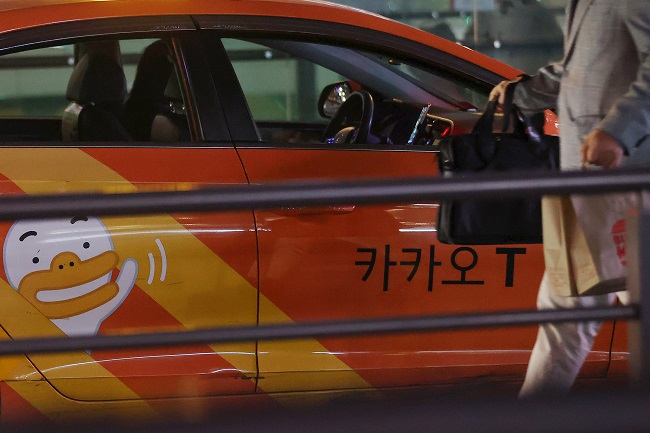
This photo shows a taxi affiliated with Kakao Mobility, South Korea’s leading ride-hailing app. (Image courtesy of Yonhap)
SEOUL, Feb. 2 (Korea Bizwire) — Kakao Mobility, the transportation arm of South Korea’s Kakao Group, is moving to refocus its business on autonomous driving and robotics after prosecutors cleared the company of major antitrust and accounting allegations that had weighed on it for years.
On Jan. 26, the Seoul Southern District Prosecutors’ Office concluded that Kakao Mobility had not violated competition law in its taxi dispatch system, nor breached accounting standards in the way it recognized franchise fees, according to the company and legal officials. The findings close two of the most serious investigations stemming from accusations that Kakao unfairly favored its affiliated taxi fleets and inflated revenues.
The rulings mark a turning point for the company, which has faced sustained regulatory scrutiny since 2021. An earlier administrative lawsuit had already overturned a 27.1 billion won ($20 million) fine imposed by the Fair Trade Commission over alleged “call 몰아주기,” or preferential allocation of ride requests.
Kakao Mobility and its chief executive remain on trial in a separate case involving allegations that some ride requests were blocked, but the company said it would “respond faithfully” and denied any intent to restrict competition.
With much of the legal uncertainty now resolved, Kakao Mobility is repositioning itself around what it calls “physical AI,” a strategy that integrates artificial intelligence with real-world systems such as self-driving vehicles and delivery robots.
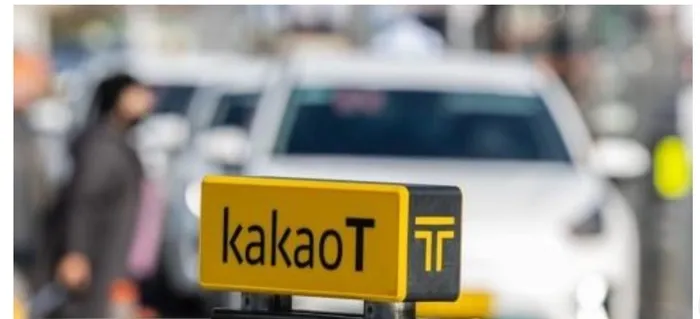
Kakao Mobility updated its taxi platform ‘Kakao T’ to allow users to rent cars on a per-minute basis in 2024 (Image courtesy of Yonhap)
The company plans to accelerate commercialization of autonomous driving and robotic delivery services, drawing on data and operational expertise accumulated through its Kakao T ride-hailing app and Kakao Navi navigation platform. Those systems have generated extensive datasets on routing, dispatch and traffic control, which Kakao Mobility sees as a competitive advantage.
Earlier this month, the company joined the AI Future Vehicle M.AX Alliance as a lead participant in autonomous driving, pledging to develop a Korea-specific end-to-end AI driving model optimized for local road conditions. Kakao Mobility has already tested autonomous services in cities including Sejong, Pangyo, Gangnam, Daegu and Jeju.
It is also expanding robot-based logistics through its delivery service, Bring, which aims to deploy multipurpose robots capable of food delivery, internal office logistics and hotel concierge tasks.
Organizational changes are underway to support the shift. Kakao Mobility recently established a dedicated physical AI division and appointed Kim Jin-kyu, a former researcher at Waymo and Honda, to lead the unit.
Industry observers say the conclusion of the investigations could allow Korean platform companies to resume long-term investments in advanced algorithms and emerging technologies. “With legal risks easing, the focus can return to competing globally in AI and mobility,” one industry official said.
Kakao Mobility maintains that even in the remaining criminal case, it will demonstrate that no unlawful conduct occurred. For now, the company is betting that autonomy and robotics will provide a fresh growth engine after years of controversy surrounding its role in reshaping South Korea’s taxi industry.
Kevin Lee (kevinlee@koreabizwire.com)