On May 20, when Daegu’s daytime high soared to 33.4°C, a candidate washes his face with cool water after completing the physical fitness test for recruitment into Daegu’s Disaster and Safety Response Unit at Daegu Stadium. (Image courtesy of Yonhap)
SEOUL, May 24 (Korea Bizwire) — South Korea is likely to face another unusually hot summer this year, according to the Korea Meteorological Administration (KMA), which on Thursday released its climate outlook for June through August.
The agency forecast higher-than-average temperatures across the country, driven by global oceanic heat and high-pressure systems that could lock in oppressive conditions.
The KMA’s projections show a 50% probability that July and August temperatures will exceed historical averages, compared to just a 10% chance they will be cooler. June is also expected to be hotter or near-normal, with only a 20% chance of cooler-than-average conditions.
The findings are supported by data from 474 climate models used by 11 global weather agencies, including the European Centre for Medium-Range Weather Forecasts (ECMWF) and the U.S. National Oceanic and Atmospheric Administration (NOAA). Ensemble forecasts suggest a 71% chance of above-average temperatures in August alone.
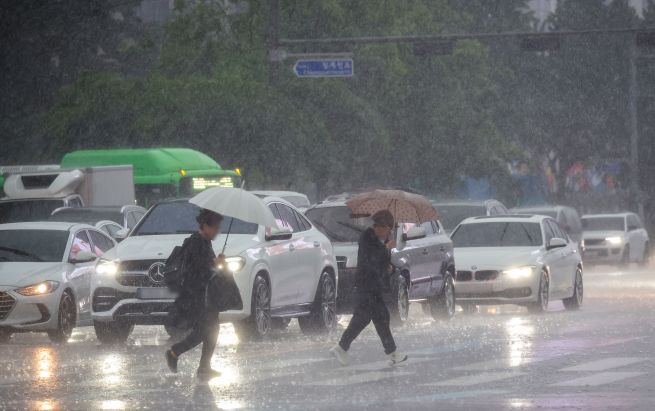
On May 16, amid rainfall, pedestrians walk with umbrellas at Gwanghwamun Intersection in Seoul. (Yonhap)
High-Pressure Systems and Warm Seas to Blame
The KMA attributed the expected heat to elevated sea surface temperatures in the western Pacific and Indian Oceans, which increase atmospheric convection. This, in turn, drives a pattern of rising air over the tropics and descending air over East Asia — a mechanism that helps form high-pressure systems near Korea. These systems bring in hot, humid southerly winds that trap heat across the Korean Peninsula.
A similar pattern contributed to the record-breaking heat in the summer of 2024, though the KMA noted this year may be milder in comparison, as ocean temperatures remain elevated but not as extreme, and the El Niño event that influenced last summer has since dissipated. Currently, global climate conditions are in a neutral state, with neither El Niño nor La Niña in effect.
Regional factors may also amplify the heat: reduced snow cover in Europe this spring may weaken surface cooling and trigger further high-pressure formation via atmospheric wave patterns, while warm Indian Ocean waters are also expected to foster convection and promote heat across East Asia.
However, the KMA noted that some cooling factors may come into play. Increased snow cover in Tibet could weaken the powerful Tibetan high that often brings intense midsummer heat. Additionally, low snow accumulation in northeastern China may lead to low-pressure systems that could help moderate Korea’s temperatures.
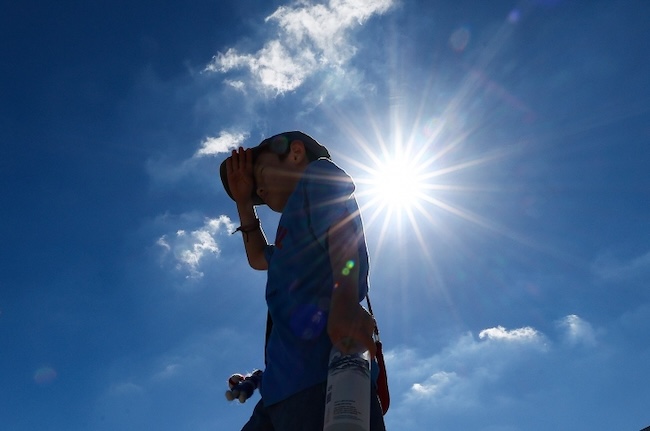
The summer heat (Image courtesy of Yonhap)
Rainfall to Be Abundant in June, Average Thereafter
Rainfall is expected to be higher than average in June, with a 40% chance of above-normal precipitation. July and August are likely to see average rainfall levels, though the KMA warned that persistent high-pressure conditions and warm sea temperatures could still lead to sudden, intense downpours.
The high sea surface temperatures in the Indian and western Pacific Oceans are also contributing to this outlook. Warm seas enhance the inflow of moist, tropical air, creating conditions ripe for frequent summer showers.
Typhoon Activity Likely Normal or Below Average
Despite warm sea temperatures that typically favor typhoon formation, the KMA expects typhoon activity to be average or slightly below normal this year, with a 40% chance of two to three typhoons affecting Korea — the usual annual figure — and only a 20% likelihood of above-average activity.
Unusually, no typhoons have formed yet in the northwestern Pacific in 2025, a delay attributed to a stronger-than-normal Pacific high-pressure system suppressing storm formation.
Still, the agency cautioned that typhoons forming near Taiwan or southeast of Japan could potentially curve northward toward Korea if the Pacific high shifts.
As summer nears, the message from Korea’s weather agency is clear: prepare for heat, humidity, and sudden storms — and stay alert to shifting global weather dynamics that increasingly influence the country’s seasonal extremes.
M. H. Lee (mhlee@koreabizwire.com)