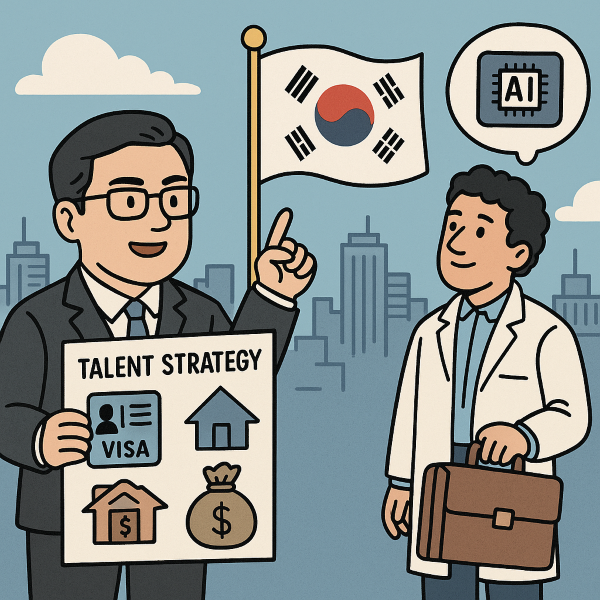
From Brain Drain to Brain Gain: Korea Rolls Out Red Carpet for Tech Elites (Image supported by ChatGPT)
SEOUL, Aug. 7 (Korea Bizwire) — South Korea is drafting an ambitious policy blueprint aimed at curbing the outflow of high-level science and technology talent while aggressively courting top-tier researchers from overseas, particularly in the field of artificial intelligence.
According to government officials, the Ministry of Science and ICT has identified an initial demand for about 150 elite science and technology professionals—considered critical to advancing South Korea’s competitiveness in next-generation sectors like AI, semiconductors, and defense technology. The government plans to unveil a draft of the strategy at a multi-agency task force meeting on August 12.
Among the proposals under review are the creation of a new “top-tier visa” category, expanded residency support, and generous research funding. Authorities are also exploring direct government subsidies for salaries and research expenses for foreign scientists recruited through major AI research consortiums.

One such initiative, the “Independent AI” program, seeks to cultivate a homegrown foundation model team to rival those developed by global tech giants. Through this program, selected consortiums can receive up to 2 billion won (about $1.5 million) annually per top-tier researcher to support recruitment and project development.
Upstage, one of the five selected consortiums, has already secured priority funding after meeting early performance benchmarks.
The visa program, led by the Ministry of Justice, was launched in April to attract talent in AI, robotics, and defense industries. The government is now considering expanding eligibility to graduates of top 200 global universities.
“These are the kinds of candidates being offered astronomical salaries by U.S. tech firms—sometimes exceeding those of NBA superstars,” said a senior official at the science ministry. “To compete, we must make Korea a destination for the world’s best minds.”
The push comes as neighboring Taiwan, once a net exporter of talent, has reversed the trend through aggressive government support. Taiwan now boasts a thriving startup ecosystem fueled by returning diaspora, including former Google engineers who have launched the island’s first AI unicorn.
South Korea hopes to follow suit by not only attracting foreign experts, but also cultivating a domestic ecosystem in which global talent can live, work, and innovate. “We need the private sector to step up with bold offers,” said one AI industry expert. “It’s no longer just about competing on technology, but also on talent.”
M. H. Lee (mhlee@koreabizwire.com)