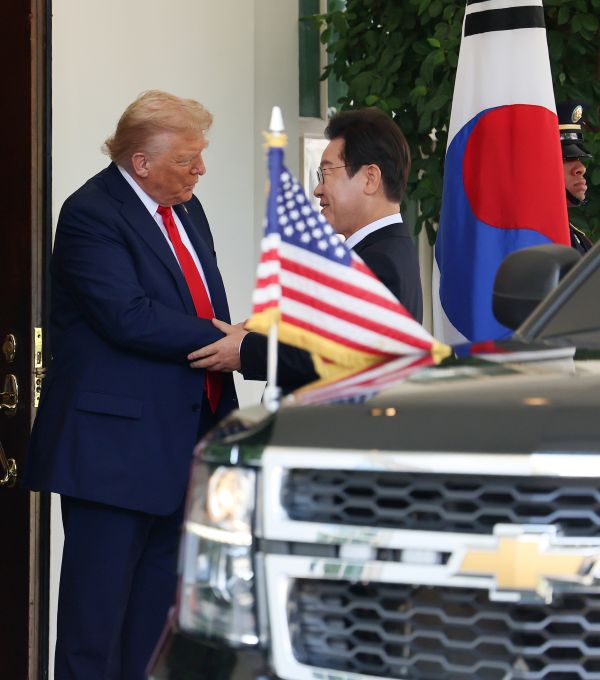
South Korean President Lee Jae Myung (R) is greeted by U.S. President Donald Trump ahead of their talks at the White House in Washington on Aug. 25, 2025. (Yonhap)
WASHINGTON, Aug. 26 (Korea Bizwire) — President Lee Jae-myung of South Korea arrived at the White House this week intent on forging personal chemistry with President Donald J. Trump.
Over lunch, they swapped stories about surviving assassination threats; at the cameras, they traded quips about building golf courses and Trump Towers in North Korea.
But beneath the warmth and theatrics of their first face-to-face summit lay questions that could shape the next chapter of the U.S.–South Korea alliance: how to manage an emboldened Pyongyang, how to share the burdens of defense, and how far Seoul should go in aligning itself with Washington while keeping Beijing at arm’s length.
The meeting came just weeks after the two countries hammered out a sweeping trade arrangement, cutting proposed tariffs on Korean exports in exchange for a $350 billion investment pledge, including $100 billion earmarked for U.S. energy.
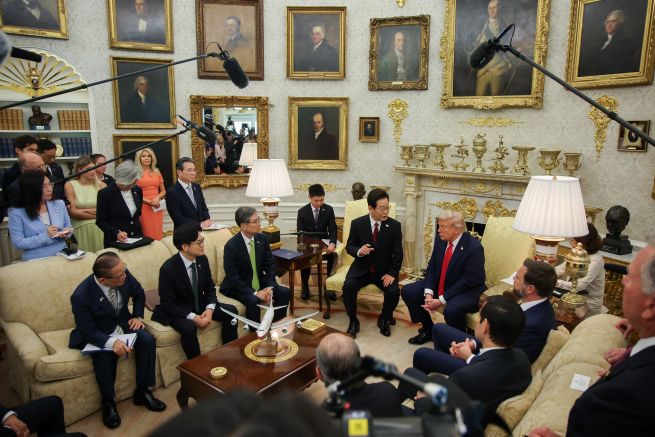
South Korean President Lee Jae Myung (4th from L, front) holds talks with U.S. President Donald Trump (5th from L, front) in the Oval Office of the White House in Washington, D.C., on Aug. 25, 2025. (Yonhap)
Mr. Lee used the occasion to spotlight a signature initiative — a $150 billion commitment to revive the American shipbuilding industry under the banner “Make American Shipbuilding Great Again,” or MASGA. Korean companies also promised a further $150 billion in foreign direct investment in semiconductors, electric vehicles and batteries.
For Mr. Lee, the gathering was as much about optics as policy. He cast himself as an eager partner to Mr. Trump’s unconventional diplomacy, even urging him to reprise his high-stakes summitry with Kim Jong-un of North Korea.
“I look forward to your meeting with Kim Jong-un, and construction of Trump Tower in North Korea and playing golf there,” Mr. Lee said with a grin. Mr. Trump smiled back and said simply, “We will work on that.”
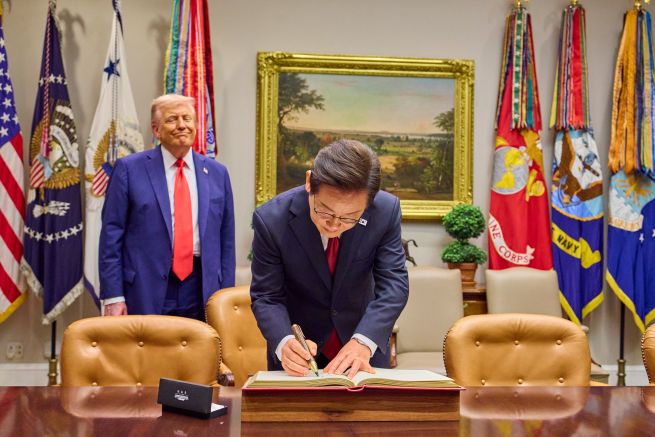
South Korean President Lee Jae Myung (C) signs the guest book at the White House in Washington on Aug. 25, 2025, with U.S. President Donald Trump looking on. (Pool photo) (Yonhap)
The levity masked grimmer realities. North Korea only days earlier had spurned Mr. Lee’s latest peace overture, while deepening its military ties with Russia. Mr. Trump, meanwhile, has signaled he remains open to another encounter with Mr. Kim, having met him three times in 2018 and 2019.
Whether such talks could yield anything new is uncertain: Pyongyang now demands recognition as a nuclear power, a stance fundamentally at odds with Washington’s call for denuclearization.
The summit also touched raw nerves in the alliance. Mr. Trump has long pressed Asian allies to raise defense spending, urging Seoul to approach 5 percent of gross domestic product, more than double its current 2.3 percent.
He has hinted at “modernizing” the alliance — language widely understood to mean expanding the role of the 28,500 U.S. troops in Korea under the doctrine of “strategic flexibility” aimed at countering China. Seoul worries such a shift could entangle it in conflicts beyond the peninsula.
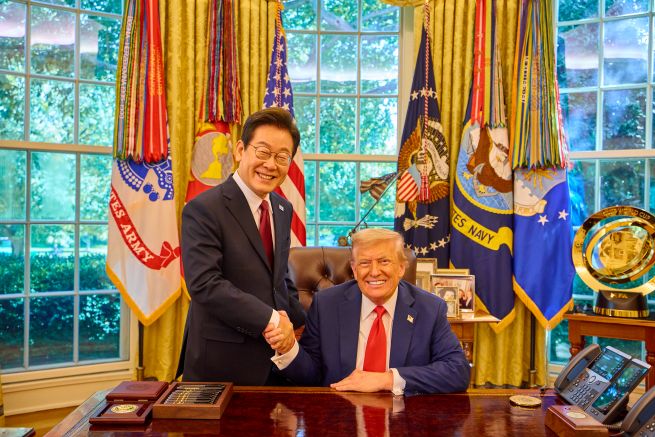
President Lee Jae Myung (L) shakes hands with U.S. President Donald Trump following their talks in the Oval Office of the White House in Washington, D.C., on Aug. 25, 2025. (Pool photo) (Yonhap)
Then came Mr. Trump’s most jarring remark: the suggestion that the United States should seek outright ownership of land provided for American bases — property that, under existing agreements, must revert to South Korea when no longer needed. Any move in that direction would likely spark fierce political backlash in Seoul.
Mr. Lee sought to smooth over tensions, emphasizing trilateral cooperation with Japan after a fence-mending visit to Tokyo days earlier. Mr. Trump echoed the sentiment, saying the two Asian neighbors had “something in common” in confronting North Korea.
Still, no joint statement followed the summit, an omission that underscored the unsettled state of the alliance. Mr. Lee’s office instead highlighted the “warm and friendly” atmosphere, noting Mr. Trump had praised him as “a very good guy” and “a very good representative for South Korea.”
The day had begun less auspiciously, with Mr. Trump posting on social media hours before the summit that South Korea was undergoing a “purge or revolution” — widely read as a reference to the detention of former President Yoon Suk Yeol over an attempted martial law plot.
By the time Mr. Lee entered the Oval Office, the president struck a softer tone. “I’m sure it’s a misunderstanding,” he said.
For Mr. Lee, the encounter offered both affirmation and uncertainty: a chance to demonstrate personal rapport with Washington’s most unpredictable partner, and a reminder that even friendly smiles can mask the hardest questions in diplomacy.
M. H. Lee (mhlee@koreabizwire.com)