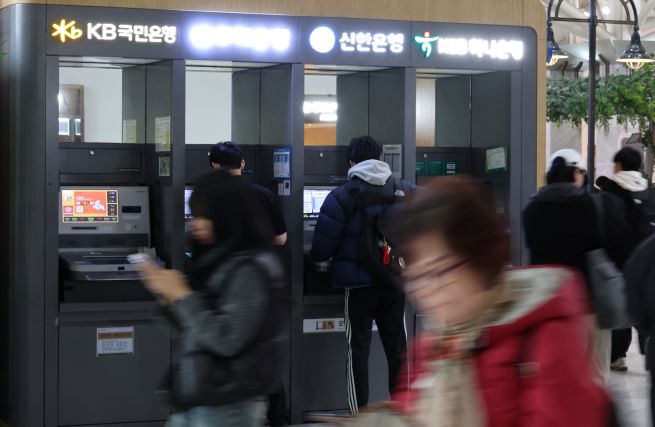
ATM machines displaying the logos of South Korea’s four major banks.(Yonhap)
SEOUL, Dec. 4 (Korea Bizwire) — Amid heightened foreign-exchange volatility this year, South Korea’s major banks have taken markedly different approaches to managing currency risk, newly released filings show.
According to third-quarter disclosures from the country’s four largest lenders — KB Kookmin, Shinhan, Hana and Woori — all maintained “long” positions in foreign currency, meaning they held more foreign assets than liabilities. But the scale and structure of those exposures differed sharply.
KB Kookmin Bank pursued the most conservative strategy, reducing its net foreign-exchange exposure from 4.35 percent of equity in January to 3.18 percent in September. Its portfolio combines short spot positions with long forward positions, a structure designed to hedge against foreign-currency debt while keeping a modest net holding. Analysts said Kookmin’s earnings are likely the least sensitive to swings in the won.
Hana Bank, by contrast, adopted the most aggressive stance. Its currency exposure reached 13.66 percent of equity in September — far higher than its peers — after four consecutive months of buying in both spot and forward markets. The strategy could yield higher gains if the won weakens further, but also leaves Hana more vulnerable if the currency strengthens.
Woori Bank mirrored Kookmin’s cautious approach, maintaining short spot and long forward positions while reducing its exposure to 5.88 percent of equity by September, down from 8.04 percent at the start of the year.
Shinhan Bank increased its exposure in the second half, reaching the high-8 percent range by September. The bank said it scaled back hedging on assets tied to its overseas network, leading to expanded forward purchases.
Across the sector, banks appeared to be trimming foreign-currency assets overall to protect capital ratios. A weaker won inflates the value of foreign-currency–denominated risk-weighted assets, potentially eroding regulatory capital.
As of September, KB Kookmin, Hana and Woori all reported declines in foreign-currency assets compared with a year earlier — part of a broader effort to contain risk as exchange-rate volatility persists.
Ashley Song (ashley@koreabizwire.com)