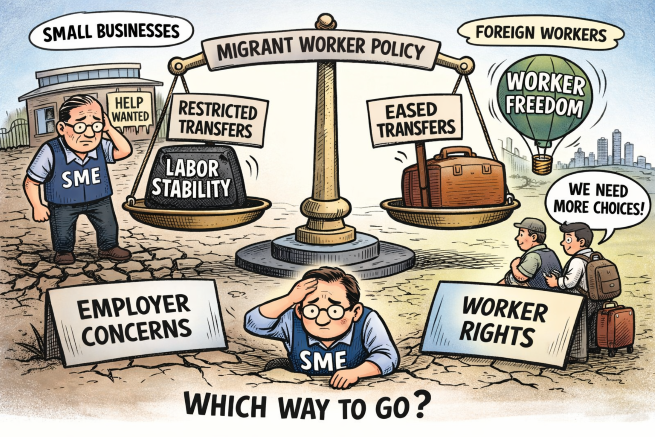
A Policy Trade-Off: Worker Mobility Versus Small Business Stability (Image supported by ChatGPT)
SEOUL, Jan. 29 (Korea Bizwire) — About half of South Korean small and medium-sized enterprises that employ foreign workers support easing restrictions on job changes under the country’s employment permit system, though many remain wary of the impact such reforms could have on already fragile labor supply, a new survey showed Wednesday.
According to a poll released by the Korea Federation of SMEs, 51.3 percent of respondents said it would be appropriate to allow foreign workers on E-9 visas to change workplaces after an initial restriction period of one or two years. By comparison, 48.7 percent favored maintaining the current rule, which generally limits job changes during the first three years of employment.
The survey was conducted among 310 small businesses currently employing foreign workers, as the Labor Ministry reviews potential revisions to the system amid criticism that existing rules excessively limit migrant workers’ freedom of movement.
Under current regulations, E-9 visa holders are expected to remain at their original workplace unless specific conditions — such as unfair treatment, contract termination or labor law violations — justify a transfer.
The findings suggest growing recognition among employers that some degree of mobility may be unavoidable. At the same time, concerns remain widespread. Nearly three-quarters of surveyed firms said they had already received job-change requests from foreign workers, with more than 70 percent occurring within the first year of arrival. Over one-third said such requests came within the first three months, particularly in non-metropolitan regions.
The most frequently cited concern over easing restrictions was the risk of deepening labor shortages at small businesses, a fear expressed by more than 60 percent of respondents. The concern was especially pronounced outside the Seoul metropolitan area, where companies warned that greater worker mobility could worsen regional labor imbalances.
If restrictions are relaxed, businesses called for safeguards, including preferential reassignment of replacement workers to affected firms and penalties for job changes not attributable to employer fault. Many also urged expanded government support for worker housing costs and greater transparency regarding workers’ job-change histories.
“While protecting the rights of foreign workers is essential, reforms must also take into account the sustainability of small businesses and regions facing population decline,” Yang Ok-seok, head of labor policy at the federation, said.
The results highlight the delicate balance policymakers face as South Korea seeks to modernize its migrant labor system while preventing unintended strain on the small firms that depend heavily on foreign workers.
M. H. Lee (mhlee@koreabizwire.com)