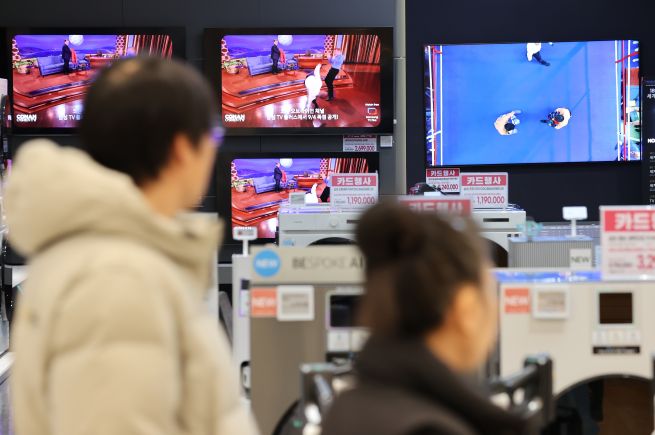
China has already surpassed South Korea in terms of TV shipment volume. (Yonhap)
SEOUL, May 5 (Korea Bizwire) — Global shipments of premium liquid crystal display televisions equipped with mini LED technology are projected to reach an all-time high this year, driven by aggressive expansion and innovation from Chinese manufacturers, according to market research firm TrendForce.
The firm estimates that 11.56 million mini LED TVs will be shipped in 2025, marking a 50% year-on-year surge. Mini LED TVs are a form of LCD TV that use densely packed, microscopic light-emitting diodes—typically between 100 and 200 micrometers in size—for their backlight, significantly improving contrast ratios while maintaining a cost advantage over OLED and micro LED alternatives.
Chinese electronics maker TCL first introduced the technology in 2019, followed by competitors like Hisense and Xiaomi. This year, both TCL and Hisense showcased AI-enhanced mini LED TVs at CES 2025 in Las Vegas, with TrendForce projecting the two companies will jointly command 64% of the global mini LED TV market.
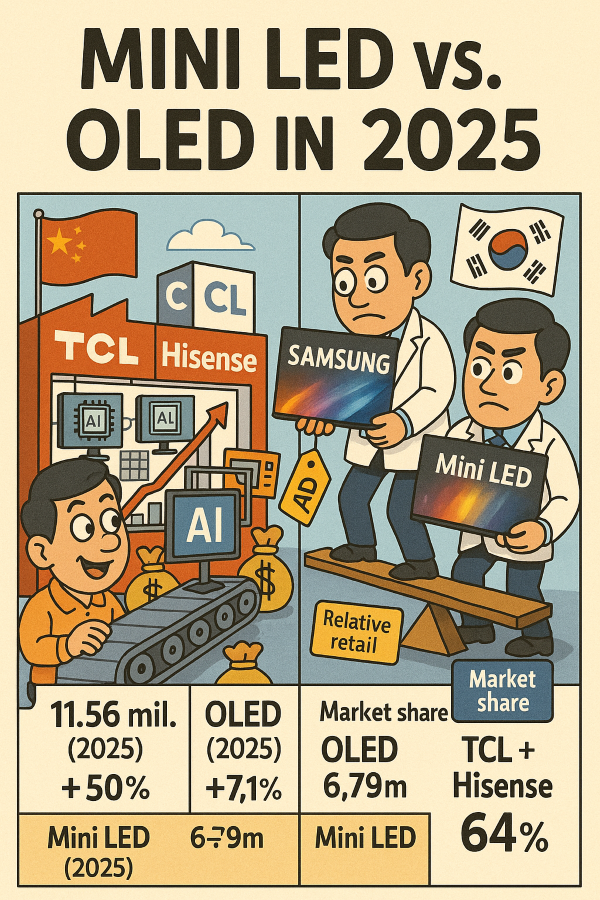
TCL and Hisense set to capture 64% of the market in 2025, challenging Korea’s OLED dominance with aggressive pricing and AI innovation. (Image supported by ChatGPT)
Analysts attribute China’s rapid ascent in the sector to its dominance in the LCD panel supply chain. Chinese panel makers, such as TCL’s display subsidiary CSOT (China Star Optoelectronics Technology), have vertically integrated their production capabilities, securing cost-effective access to key components.
The Chinese government’s supportive subsidy programs—like “trade-in” incentives that encourage consumers to replace old appliances—have further accelerated domestic demand.
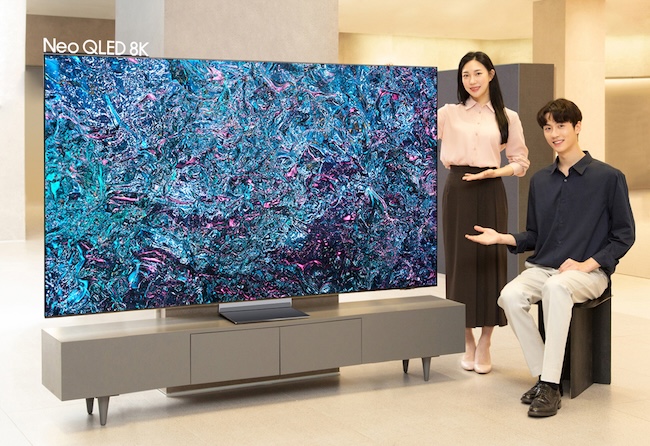
Samsung Neo QLED 8K TV (Image courtesy of Samsung Electronics)
While Chinese firms tighten their grip on the mini LED segment, OLED TV shipments—traditionally led by South Korean manufacturers—are expected to grow more modestly. OLED TV shipments are forecast to rise by 7.1% in 2025 to 6.79 million units, remaining in the 6 to 7 million range for the foreseeable future.
TrendForce noted that OLED TVs face structural limitations, including panel production capacity and retail prices that are three to four times higher than those of mini LED TVs. “In the mid-to-long term, OLED TVs face mounting challenges,” the firm warned.
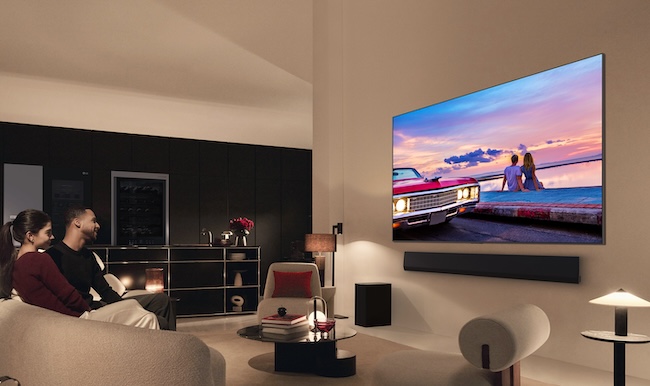
The 2024 LG OLED·QNED TV (Image courtesy of LG Electronics)
In response to the shifting dynamics, South Korean tech giants Samsung Electronics and LG Electronics are doubling down on mini LED. Samsung, which launched its Neo QLED 8K and 4K series in 2021, is expanding its lineup this year with new models like the Frame Pro.
LG, meanwhile, is continuing its dual-track strategy by offering both OLED and QNED TVs—the latter also employing mini LED backlighting.
The evolving competition between mini LED and OLED technologies signals a broader reconfiguration of the premium TV landscape heading into 2026, with Chinese firms gaining momentum and Korean players recalibrating to defend their long-held dominance.
Kevin Lee (kevinlee@koreabizwire.com)